

IRINFO Banner Image  


2010
January 4, 2010

Sponsored by:

Sponsored by:


IR Inspections of Parking Garage Ceilings

~ Tip Coauthored by Wayne Swirnow
Infrared Imaging Services


When inspecting building envelopes for heat loss, thermographers tend to focus their imaging efforts on the sidewalls and roof.  For some buildings, it is important to also thermographically inspect the underside of the building.

In many parts of the United States a common building practice for commercial structures is to elevate the building on support columns and place an unheated parking garage directly below the first story.  This practice exposes the underside of the first occupied level and its associated plumbing to the outside environment.

In colder regions a common approach is to construct a suspended ceiling for the garage and to create a heated space between the underside of the first occupied floor and the garage ceiling so that water, waste, and sprinkler pipes do not freeze. To minimize heat loss, batts of glass fiber insulation are often laid directly on top of the ceiling tiles.
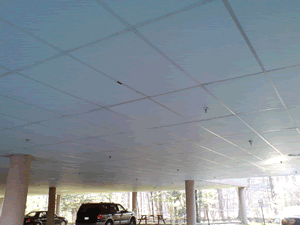
Photo shows typical suspended ceiling in open parking garage.
  Image provided by Wayne Swirnow

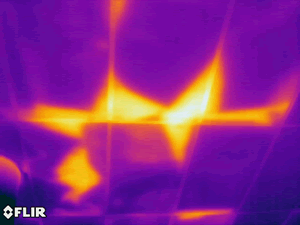
When performed under proper conditions, an infrared inspection of the garage ceiling can quickly reveal thermal patterns caused by missing, misapplied, or damaged insulation.  Areas exhibiting excess energy loss may then be visually inspected to ascertain cause.
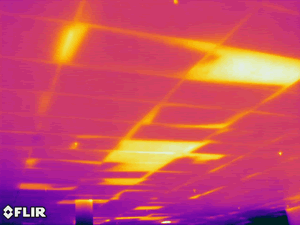
Thermal images indicate areas
of missing
batt insulation
as warm areas.


Images
provided by
Wayne Swirnow.


Infrared inspection of building envelopes is of the many topics covered in the Infraspection Institute Level I Certified Infrared Thermographer® training course.  For course information or to obtain a copy of the Standard for Infrared Inspection of Building Envelopes, visit Infraspection Institute online or call us at 609-239-4788.


January 11, 2010

Sponsored by:

Sponsored by:


Detecting Electrical System Overloads


Statistically, overloaded circuits are the second most common cause of exceptions found during infrared inspections of electrical systems. Although overloads are quite common, they can be tricky to accurately diagnose.

As electrical current flows through a conductor, heat is generated. As circuit load increases, so does the amount of heat. Electrical circuits are designed so that loads will not exceed the circuit’s ability to safely carry a sustained load and the amount of heat associated with such load.

Typically, overcurrent protection devices such as fuses or circuit breakers are designed to protect circuits from overload conditions. These devices will interrupt the circuit when the current reaches a predetermined level for a specified period of time.

Serious problems such as fires can be caused by sustained overloads. Such overloads may be caused by: improperly sized wiring, and improperly sized or defective overcurrent protection. Fortunately, a thermal imager can be used to detect the thermal patterns associated with sustained overloads.

When using a thermal imager to detect potential overloads, one should keep the following in mind:

  • Overloaded conductor(s) will be uniformly warm throughout entire length
  • For polyphase circuits, all conductors may be uniformly warm
  • Depending upon ambient conditions and imager settings, overloaded circuits may not appear remarkably warmer than adjacent circuits

Because an infrared imager cannot measure electrical current, suspected overloads must be confirmed with an ammeter while observing all requisite safety precautions. For greatest accuracy, a true RMS sensing ammeter is recommended. Circuits found to be overloaded should be immediately investigated for cause and corrected.


January 18, 2010

Sponsored by:

Sponsored by:


Compensating for Reflected Temperature


When performing infrared temperature measurements, reflected infrared energy can be a significant error source. This potential error source can be overcome by using the proper radiometer and test procedure.

All thermographers have experienced reflected energy when inspecting low emittance targets. For qualitative imaging, single-point reflections may be avoided by changing viewing angle.

With quantitative imaging, failing to compensate for reflected energy can account for significant measurement errors. The infrared energy received by a radiometer is the sum of emitted, reflected and transmitted energy (E+R+T=1.0). For targets with a transmittance of zero, the error sources are emittance and reflectance. Using a quality radiometer, reflected energy can be measured and compensated for by using the Reflector Method described below.

1. Set radiometer Emittance control to 1.00

2. Locate radiometer at desired distance from target to be measured

3. Aim and focus imager

4. Position diffuse reflector in front of, and parallel to, face of target

5. Measure apparent temperature of reflector surface and remove reflector

6. Enter value obtained in Step 5 into radiometer’s computer under reflectance input – commonly labelled Background, TAmbient, or Reflected Temperature.

Lastly, be sure to maintain a safe working distance from any energized or potentially dangerous targets.

The topic of reflected temperature is covered in depth in the Infraspection Institue Level II Certified Infrared Thermographer training course. Copies of Infraspection Institute’s Standard for Measuring and Compensating for Reflected Temperature Using Infrared Imaging Radiometers are available in PDF format from the Infraspection Online Store.


January 25, 2010

Sponsored by:

Sponsored by:


How Delta T's Understate Priorities

Tip written by: Infraspection Institute


For years, thermographers have traditionally reported apparent Delta T measurements when documenting their findings. Using a default emittance value between .8 and 1.0, apparent temperature measurements are recorded regardless of actual target emittance. While this methodology is fast and easy, it can lead to significantly understated Delta T repair priorities.

The temperature displayed by a radiometer is largely dependent upon the emittance and reflected temperature values entered into the radiometers computer. Typically, errors in either of these settings will cause temperature measurement errors that are exponential in nature and can cause large errors in reporting Delta T’s.

Example: Using an emittance value of 1.0 a thermographer measures the apparent Delta T between two, uninsulated electrical bus bars to be 44ºC. How much can observed temperature vary due to emittance values?

Emittance 1.0 .90 .80 .50 .20
Comp 1 86 94 102 143 265
Comp 2 42 46 51 73 124
Delta T 44 48 51 70 141

From the above, the following observations can be made:

  • Emittance can have a significant impact on Delta T measurements
  • The greater the variation between an object’s true emittance and radiometer settings, the more understated the Delta T
  • Repair priorities may be significantly understated if accurate emittance values are not utilized

As there is no way to correct for errors introduced by apparent Delta T measurements, thermographers should utilize correct emittance values whenever possible. As always, all thermal anomalies detected during an infrared inspection should be investigated and proper corrective measures undertaken as soon as possible.


February 1, 2010

Sponsored by:

Sponsored by:


Understanding Imager Resolution

Tip written by: Infraspection Institute


Resolution is one of the most important objective specifications for a thermal imaging system. Due to a lack of standardization, this term is used in a variety of ways, many of which can be confusing or misleading.

Simply stated, resolution describes the capability of a thermal imager to clearly depict a target. Imager resolution is determined by an interdependent set of circumstances, the most important of which are described below.

  • Detector: Some manufacturers offer total pixel count of the detector as a measure of resolution. Resolution generally increases with the number of pixels; however, pixel viewing angle (IFOV) also affects detector resolution. Meaningful IFOV data are frequently unavailable.
  • Optics: Changing lenses affects an imager's ability to clearly resolve a target at a given distance. Generally, telescopic lenses increase optical resolution; wide angle lenses decrease resolution.
  • Signal-to-noise ratio: Generally, higher ratios equate to increased image resolution. Imagers with poor ratios will provide imagery that is grainy, thereby compromising image quality.
  • Display Monitor: To maximize performance, the pixel count of an imager display monitor should equal, or exceed the number of detector pixels. Compact or monocular displays can severely limit resolution. Use of a high resolution monitor cannot compensate for low detector resolution.

When considering an imager for purchase, be certain to try the imager under the same circumstances that you will encounter in the future. Because there is no objective method to determine imager resolution, one should physically compare subject imagers to each other.

Infrared imager operation and maintenance are two of the many topics covered in the Infraspection Institute Level I Certified Infrared Thermographer® training course. For more information or to register for a course visit us online at www.infraspection.com or call us at 609-239-4788.


February 8, 2010

Sponsored by:

Sponsored by:


Contracts for Infrared Inspections

Tip written by: Infraspection Institute


A perpetual quest among professional thermographers involves seeking a standard contract for their inspection services.  In this Tip, we offer a time-tested solution that can help to increase sales and improve customer satisfaction.

A contract is a binding legal agreement that is enforceable in a court of law. Simply put, a contract is an exchange of promises, which if broken, have remedy in the law.  Among other things, an infrared inspection contract should address the responsibilities of the thermographer and the client, work to be performed, applicable standards and procedures, pricing, delivery, and payment terms.

Due to the diverse nature of infrared inspection services, preparing a one-size-fits-all contract can be very difficult.  This challenge becomes even greater when ancillary services such as providing electricians or moisture verification are required as part of a project.  In many areas, preparing a contract requires the assistance of a legal professional in order to ensure that the final contract meets all regulatory and legal requirements.

For professional thermographers, the first step in approaching any new project should be to generate a formal proposal.  This proposal should contain all information pertinent to the project and be sufficiently detailed to reflect the responsibilities of all parties including the client and the thermographer.  Once a proposal has been deemed satisfactory by a client, a Purchase Order or contract may then be prepared and forwarded to the thermographer for review and acceptance. 

Infraspection Institute offers standard proposal templates for several different types of residential and commercial infrared inspections. Each template provides suggested wording and format for preparing a comprehensive and professional proposal.

Eight proposal templates are currently available covering the following applications: electrical systems, mechanical systems, electro/mechanical systems, building envelopes, insulated roofs, process equipment, steam traps, and underground piping.  Each template outlines scope of work, pricing options, client and thermographer responsibilities, applicable standards, additional services, and terms.

All templates are provided in a Microsoft Word file and can be modified to suit the user's particular needs. Templates may be used as core language for contract documents.  Purchase price includes license for unlimited use of template by the original purchaser. Templates are available individually or as a complete set of eight through the Infraspection Online Store.


February 15, 2010

Sponsored by:

Sponsored by:


Calculating the Value of an Electrical Hotspot


What is the financial liability of a hotspot within an electrical system? Probably less than you think since electrical hotspots waste surprisingly little energy even when operating at high temperatures.

Over time, many have stated that the cost of infrared inspections can be justified through the detection and subsequent repair of hotspots associated with loose/deteriorated electrical connections. Although these types of defects can produce temperature rises of hundreds of degrees, the amount of energy wasted in the form of excess heat is often surprisingly small.

When detected in their formative stages, loose/deteriorated connections may contribute to only a few watts of energy loss. Even large temperature rises associated with significantly degraded connections will usually produce energy losses of less than 100 watts. We can calculate the financial impact of such an exception as follows:

0.1 kw x 24 hours = 2.4 kwh per day

2.4 kwh x 365 days per year = 876 kwh per year

876 kwh per year x $0.14 per kwh = $122.64 per year

It is important to note the above illustration is for an extreme hotspot operating undetected 24 hours per day for an entire year. While the above potential savings may seem significant, it would be hard to justify the expense of an infrared inspection program based upon energy savings alone. Justification would be even harder if the dissipated energy were only a few watts.

The real value of information obtained from infrared inspections comes from reducing unscheduled downtime, increasing reliability, improving safety, and avoiding losses associated with catastrophic failure.

Infrared inspection of power distribution systems is one of the many topics covered in the Level I Infraspection Institute Certified Infrared Thermographer® training course. For information on thermographer training or to obtain a copy of the Standard for Infrared Inspection of Electrical Systems & Rotating Equipment, visit us online at www.infraspection.com or call us at 609-239-4788.


February 22, 2010

Sponsored by:

Sponsored by:


Using a Blower Door
During an IR Inspection

Tip written by:
Infraspection Institute


Data obtained during infrared inspections can often be improved by incorporating other tools. When it comes to building inspections, a blower door can be useful in detecting air leakage sites and helping to gauge the airtightness of a building.

Air leakage is often a major source of energy loss in buildings. Although an infrared imager can help detect evidence of air leakage sites, it cannot pinpoint all air leakage sites nor can it quantify the amount of air leakage occurring. Many thermographers overcome these limitations by utilizing a blower door in conjunction with their infrared inspection.

A blower door consists of an instrumented, high volume fan that is temporarily placed in a doorway to create a positive or negative pressure within a building. In depressurized mode, the blower door simulates a wind blowing equally on all sides of the building. Conducting an infrared inspection with the building depressurized enables a thermographer to detect air leakage sites that would not be visible under natural conditions. With special software, it is possible to estimate the relative leakage of a structure as well as the total area of all leak sites.
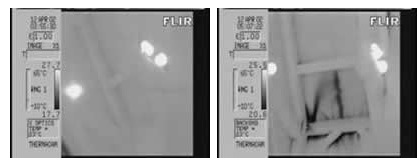

Natural condition

Depressurized condition

A blower door can provide a thermographer with some advantages; however, there are challenges associated with their use. Using a blower door during an infrared inspection represents a “worst case” scenario and may not be indicative of natural conditions. This may invalidate thermal imagery that is destined for use in a legal case. Since blower doors can cause backdrafts from fireplaces, stoves, and heating equipment, they should be operated only by persons who are properly trained in their application and use.

Infrared inspection of building envelopes is one of the many topics covered in the Infraspection Institute Level I Certified Infrared Thermographer® training course. For more information or to register for a course, visit Infraspection Institute or call us at 609-239-4788.


Visit Infraspection Institute Web Site


March 1, 2010

Sponsored by:

Sponsored by:


Preventing Falls in Icy Weather

~ Tip provided by Conoco Phillips


Numerous injuries result from slips and falls on icy sidewalks, parking lots, roads and other outdoor locations every year. Snow removal, sanding and salting of these type areas can help but, many times, total elimination of snow/ice hazards are impossible and other measures must be used to cope with these problems.
 
Focus on your walking path and pick steps that minimize or eliminate your exposure to icy slips.  This is a time during which keeping your "eyes and mind on path" is more critical than ever.  
 
Accept and anticipate the fact that you are at risk of falling at any given moment when walking on ice. Adjust your stride so your center of gravity is maintained as directly above your feet as possible by taking shorter steps than usual.

Don't ignore the hazard presented by a slippery surface in your immediate path or work area.  Take the time to spread sand, salt, or calcium chloride on icy areas and notify your Supervisor if further action is necessary. Keep in mind that salt (chloride) containing material is incompatible with stainless steel and is not to be used where contact can be made.
 
Footwear should have slip resistant soles. Avoid leather soled shoes. Equate this to driving a car with bald tires in the winter. You need something suitable to grip the surface you intend to walk on.
 
Wipe your feet off at the entrance of buildings so others won’t slip and fall on melted snow that has been tracked into the building.
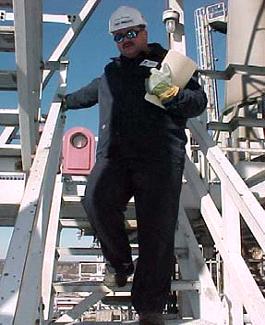
 
Like the ice under your feet, beware of icicles over your head; they can be dangerous. Although you cannot stop them from forming, you can minimize their effects by controllably knocking them down.
 
Whether you’re dealing with an overhead or underfoot ice hazard, if you can’t control it, barricade or rope the area off.

When walking down stairs with or without an item in one hand, Safety In Motion has a technique that can reduce your chance of falling down the stairs. Grasp the handrail in the palm up position trailing behind you instead of your direction of travel. Your feet should be positioned at a slight angle toward that railing. Should you loose your balance, your grip on the handrail in this position will cause you to come to a stop against the handrail instead of falling down the stairs. Try the technique and become comfortable with it before you need it. Make protecting yourself a top priority!


Visit Infraspection Institute Web Site


 
March 8, 2010

Sponsored by:

Sponsored by:


Infrared Inspection of Parallel Feed Conductors

~ Tip provided by Jim Brady
Brady Infrared Inspections, Inc.


Parallel conductors are a common feature on many electrical circuits.  When properly used, an infrared imager can detect evidence of serious problems that might otherwise go undetected.

Insulated conductors play a vital role in electrical systems by carrying current to connected devices.  Single phase circuits in receptacle and lighting panels use individual conductors to perform this function. Feeder type conductors however, are typically much larger in size and load carrying ability and quickly reach a point where it becomes impractical to install them using only one conductor per phase.  In these cases, parallel conductors are used.

In theory, each parallel conductor should be the same diameter and length for a specified feeder circuit in order that the carried load is shared evenly among the conductors.  Properly functioning parallel conductors on the same phase should exhibit equal temperatures with no discrete hotspots.

During a recent inspection at an industrial site, a 25 F degree temperature rise was observed on one of two, 400 amp rated parallel feed conductors that linked an 800 amp 3-phase breaker to the main lugs of a motor control center.  An ampere reading showed that the warm conductor was carrying 450 amps while the paired conductor had less than 1 amp.
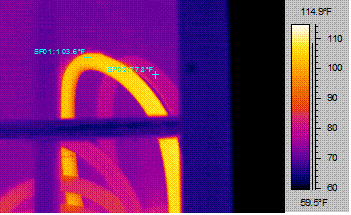
Parallel feed cables on an 800amp 3-phase breaker
showing one cable 25 F degrees warmer than its pair.

An infrared inspection at the main lug compartment of the motor control center showed the same thermal relationship as observed at the main breaker and led to the discovery of a deteriorated connection that no longer was capable of carrying load.  Under normal inspection protocol at this facility, this motor control center was not scheduled for infrared inspection for another year.  If not for our investigation as to the cause of the thermal anomaly at the main breaker, this overload condition would have persisted and potentially caused a catastrophic failure.
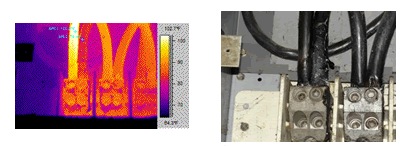
Thermal and visual images of conductor connection
at the main lug of the motor control center.

When performing infrared inspections of parallel feed conductors it is important to understand that paired conductors are sharing load and therefore should have identical thermal patterns.  Differing thermal patterns between paired conductors should always be investigated as overload conditions may develop on one or more conductors.  Conductors operating at cooler temperatures are usually the result of broken conductors, conductors of drastically different resistance, or connections that have failed completely.


Visit Infraspection Institute Web Site


March 15, 2010

Sponsored by:

Sponsored by:


Do You Have the Correct Time?


Most modern thermal imagers have the ability to record time and date along with thermal images. Taking a moment to ensure that the correct time and date are displayed on your imager before you begin your inspection can help to avoid wasted time and the collection of inaccurate data.

Having the correct time associated with your imagery is important for several reasons. With correctly dated imagery, it is possible to:

  • Accurately document when the inspection was performed
  • Easily store and uniquely reference image files
  • Record the duration of a thermal event

It is always good practice to consciously check your imager’s clock each time you start your imager and make any necessary adjustments. Be certain to check your clock periodically during your inspection and whenever you restart your imager such as after a battery change or power interruption.

If your imager frequently displays incorrect time, it may be indicative of a defective or dead internal battery. To help avoid this problem, arrange for replacement of internal clock batteries whenever you have your imager serviced or repaired.

Infrared imager operation and use are two of the many topics covered in the Infraspection Institute Level I Certified Infrared Thermographer® training course. For more information or to register for a course visit us online at www.infraspection.com or call us at 609-239-4788.


March 22, 2010

Sponsored by:

Sponsored by:


Measurement Accuracy Specifications


“A man’s got to know his limitations.” Clint Eastwood popularized this quote in a 1972 film; this sage observation can also be applied to infrared equipment.

When stating the potential accuracy of infrared thermometers, many manufacturers state radiometer accuracy as “± 2%”. The significance of this specification is often poorly understood causing many to overestimate the accuracy of non-contact temperature measurements.

An accuracy statement of “± 2%” is actually an abbreviated statement. The full statement is “± 2% of target temperature or 2º C, whichever is greater”. The full statement is required since measurement accuracy generally decreases with lower temperature targets. Furthermore, an accuracy of “± 2%” would place accuracy at 0% when measuring targets operating at 0º!

When considering an accuracy statement, it is also important to note that manufacturers derive accuracy specs under laboratory conditions using high-emittance, blackbody simulators in a controlled environment. As a result, manufacturers derive accuracy specs under “best case” conditions which may not be possible to duplicate in a given work environment.

To help ensure measurement accuracy, be certain to:

  • Always measure perpendicular to target
  • Correctly set radiometer inputs for emittance, reflected temperature, distance and humidity
  • Ensure target size is adequate for subject radiometer’s spot measurement size
  • Temporarily modifying low E targets can help to improve measurement accuracy

Lastly, real-world challenges can create situations where it is not possible to measure temperatures to the accuracy level promised by an instrument’s spec sheet. These challenges include, but are not limited to, hot or cold ambient temperatures, and the use of different lenses or filters. Whenever accurate infrared temperature measurement is not possible, one should consider using contact thermometry instead.

Infrared imager selection and operation are two of the many topics covered in the Level I Infraspection Institute Certified Infrared Thermographer® training course. For information on our open enrollment or Distance Learning courses, please visit us online at www.infraspection.com or call us at 609-239-4788.


March 29, 2010

Sponsored by:

Sponsored by:


An Emittance Greater Than 1.0 ?


According to the laws of physics, only a perfect blackbody may have Emittance of 1.0. Although the E value of real objects must be less than 1.0, some radiometers allow entry of E values exceeding 1.0. The following describes how these radiometers achieve the impossible.

Emittance is a measure of how well an object radiates energy when compared to a blackbody at the same wavelength and temperature. Emittance for any object is measured on a scale between 0 and 1.0. Since blackbodies (E=1.0) exist only in theory, real world objects will have E values of less than 1.0. The E value of an object can never exceed 1.0.

Assuming that most objects are opaque (T=0), they must be somewhat reflective. When making an infrared temperature measurement, this reflected energy represents an error source. To overcome errors due to reflections, quality radiometers have inputs for reflected temperature. By measuring reflected temperature and entering this value into the radiometer’s computer, this error source is compensated for in the radiometer’s software.

Less sophisticated radiometers often lack inputs for reflected temperature. To compensate for this, these radiometers allow the user to exceed E values of 1.0. Although this overcompensation may allow the user to match a desired reference temperature, it can lead to significant errors. For infrared temperature measurement, the best solution is to use quality radiometric equipment and eliminate or avoid reflections whenever possible.

Emittance and proper imager operation are two of the many topics covered in the Level I Infraspection Institute Certified Infrared Thermographer® training course. For information on our open enrollment or Distance Learning courses, please visit us online at www.infraspection.com or call us at 609-239-4788.


April 5, 2010

Sponsored by:

Sponsored by:


IR Inspections of Cool Roofs


Energy and environmental concerns have caused many facility owners to look to their roofing systems for ways to conserve energy. Modern roofing systems known as ‘cool roofs’ can provide savings; however, they can present challenges for thermographers who inspect them.

Over 90% of roofs in the United States are dark colored. On sunny days, temperatures of these roofs can reach 150º to 190º F causing decreased indoor comfort, increased cooling costs, and premature aging of roofing materials. Advances in roofing technology have led to the development of ‘cool roof’ systems that help to solve these challenges.

Cool roof materials have a high solar reflectance or albedo. Compared to conventional roof materials, cool roofs operate at lower temperatures since they absorb less energy from the Sun. Cool roofs also have a high thermal emittance enabling them to radiate well and shed heat quickly after sunset.

Cool roof membranes are usually made of single-ply rubber or plastic materials such as EPDM, PVC, and TPO. These materials are usually white in color and have a smooth surface. Cool roof coatings or paints are an alternative for existing low-slope roofs.

Although cool roof materials are rated to have a high emittance, thermographers should remember that this value is an average emittance value calculated in a laboratory under ideal conditions and at a perpendicular viewing angle. During an infrared inspection, smooth-surfaced roofs appear quite reflective to a thermal imager due to the low viewing angle that is usually associated with inspections performed on foot from the roof surface. This condition is most severe on cloudless nights when atmospheric humidity levels are low.

Due to the low emittance associated with smooth roof surfaces, thermographers can easily miss the small temperature differentials associated with latent moisture. In order to mitigate errors associated with low emittance, thermographers should choose a short wave (2 to 5.6 microns) thermal imager whenever inspecting a smooth-surfaced roof regardless of membrane color or material.

Infrared inspection of flat roofs and proper equipment selection are two of the many topics covered in the Infraspection Institute Level I Certified Infrared Thermographer® training course. For more information or to register for a course, visit Infraspection Institute or call us at 609-239-4788.


Visit Infraspection Institute Web Site


April 12, 2010

Sponsored by:

Sponsored by:


Spring is the Time for Infrared Roof Inspections

~ Tip written by: Infraspection Institute


With onset of warmer weather, the harshness of winter is but a fading memory for most. Left undetected, the damage caused by winter’s fury is a reality that can lead to premature roof failure. Fortunately, an infrared inspection of your roof can detect evidence of problems before they can get out of hand.

Performed under the proper conditions with the right equipment, an infrared inspection can detect evidence of latent moisture within the roofing system often before leaks become evident in the building.

The best candidates for infrared inspection are flat or low slope roofs where the insulation is located between the roof deck and the membrane and is in direct contact with the underside of the membrane. Applicable constructions are roofs with either smooth or gravel-surfaced, built-up or single-ply membranes. If gravel is present, it should be less than ½” in diameter and less than 1” thick.

For smooth-surfaced roofs, a short wave (2-5.6 µ) imager will provide more accurate results especially if the roof is painted with a reflective coating. All infrared data should be verified by a qualified roofing professional via core sampling or invasive moisture meter readings.

Infrared inspection of flat roofs and proper equipment selection are two of the many topics covered in the Infraspection Institute Level I Certified Infrared Thermographer® training course. For more information or to register for a course, visit Infraspection Institute or call us at 609-239-4788.


Visit Infraspection Institute Web Site


April 19, 2010

Sponsored by:

Sponsored by:


Insuring Equipment In Transit

Tip written by:
Infraspection Institute


Shipping infrared equipment is a frequent necessity for thermographers. Taking the time to make certain that equipment is adequately insured can help prevent bigger problems in the event of loss or damage.

Many companies insure their infrared equipment to guard against loss or damage while the equipment is in use or transit by company employees. Typically referred to as Inland Marine or Scheduled Equipment, this coverage is generally purchased in addition to the contents portion of a company's general insurance policy. In order to be covered, equipment must be specifically identified by make, model, serial number and value.

For those who find it necessary to ship equipment via a third party or common carrier, purchasing additional coverage known as 'Goods in Transit' may be a smart move. While many shipping companies offer options for 'insurance', such coverage is often quite limited and may be insufficient to properly guard against loss. In addition to providing better coverage, a Goods in Transit policy is usually less expensive than insurance offered by freight or parcel carriers.

Regardless of how you insure your equipment, be certain to review your policy with your insurance professional and understand exactly what is covered. Lastly, always make certain that equipment is covered for replacement cost rather than 'Fair Market Value'.

Care and use of infrared equipment is one of the many topics covered in the Level I Infraspection Institute Certified Infrared Thermographer training course. For more information including course locations and dates, visit us online at infraspection.com.


Visit Infraspection Institute Web Site


April 26, 2010

Sponsored by:

Sponsored by:


What Do Thermometers Measure?

Tip written by:
Infraspection Institute


When asked what a thermometer measures, most people will tell you that thermometers measure whatever they contact. The correct answer is a little more complex and is fundamental to understanding and accurately applying contact thermometry.

Contact thermometry is a common technique used in temperature measurement. Thermocouples, resistance temperature devices, thermistors, and bulb thermometers are used to gauge the temperature of a wide variety of objects, materials, and systems. Although each works on a different principle, all contact temperature devices have one thing in common: contact thermometers report their own temperature.

Because contact thermometry is often used by thermographers to confirm radiometric measurements and to calibrate infrared equipment, accuracy is extremely important. To help ensure accuracy when using a contact thermometer, keep the following in mind:

  • Select thermometer appropriate for task. Be sure to consider sensor size, thermometer sensitivity, operating range, and response time
  • Prior to use, confirm that chosen thermometer is calibrated and operating properly
  • Make certain that selected thermometer is in good contact with object
  • Allow sufficient time for thermometer to achieve thermal equilibrium with object

Prior to using a contact thermometer, make certain that the surface to be measured is safe to touch. Never use a contact thermometer on energized electrical equipment or on any machinery where contact could result in personal injury.

Advanced heat transfer and temperature measurement are some of the many topics covered in the Infraspection Institute Level II Certified Infrared Thermographer® training course. For course schedules or to register for a course, visit Infraspection Institute online or call us at 609-239-4788.


Visit Infraspection Institute Web Site


May 6, 2010

Sponsored by:

Sponsored by:


Determining Maximum Operating
Temperature for Motors


Operating temperature can have a significant impact on the service life of operating electric motors. Accurately determining maximum operating temperature for motors is critical for setting temperature limits.

One of the specifications for electric motors is maximum operating temperature. This temperature value is determined by several factors including, but not limited to, the motor’s insulation class. Exceeding the maximum temperature for a motor will shorten the life of the motor’s dielectric materials and will result in decreased service life for the motor.

In order to calculate a motor’s maximum rated temperature, one must know the motor’s ambient temperature rating and its rated temperature rise above ambient. Both of these values are generally found on the motor nameplate located on the exterior of the motor casing.

To calculate a motor’s maximum operating temperature, add the ambient and rated rise temperatures. Their sum is the maximum operating temperature for the subject motor at 100% load.
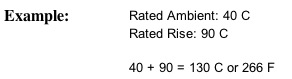
Example:

Rated Ambient: 40 C
Rated Rise: 90 C

40 + 90 = 130 C or 266 F

It is important to note that some motors specify insulation class rather than a numeric value for temperature rise. In such cases, it is necessary to know the operating limits for the insulation class of the subject motor.

The Infraspection Institute Standard for Infrared Inspections of Electrical Systems & Rotating Equipment provides temperature limits for several common insulation classes of AC and DC motors. In addition to providing inspection procedures, it also provides temperature limit data for lubricants, bearings and seals. To order a copy of the Standard, call 609-239-4788 or visit the Infraspection online store.


Visit Infraspection Institute Web Site


May 11, 2010

Sponsored by:

Sponsored by:


Detecting Delamination of Stucco


With aging infrastructure becoming an increasing concern in many communities, more attention is being focused on the maintenance of building facades. Under the right conditions, thermal imaging can detect evidence of delaminated stucco or concrete finishes on the exterior of masonry buildings.

Over time, buildings that utilize concrete stucco for exterior finishes are subject to failure. One of these failures involves the stucco delaminating from its substrate. Delaminated stucco is a serious safety concern as it can cause serious injury to pedestrians should it fall from any significant height.

When concrete stucco delaminates from its substrate, an air pocket is formed between the stucco finish and the substrate. Because this air pocket acts as an insulator, it will change the thermal capacity and/or thermal conductivity in the area of the delamination. Under the correct weather conditions, thermal imaging can detect evidence of delaminated areas.

In order to detect evidence of delaminated areas using thermal imaging, a temperature differential must be present. Typically, infrared inspections of concrete stucco are performed during evening hours following a sunny day. As an alternative, infrared inspections may also be performed during midday under solar loading conditions. Thermal patterns associated with delaminated stucco will generally be amorphous in shape and will typically appear as cold spots during post-sunset inspections or as hot spots during midday inspections.

When performing infrared inspections of concrete stucco finishes, keep the following in mind:

  • Subject surfaces should be clean and dry
  • Wall surfaces must be heated uniformly. Areas in shadow or shade may not produce accurate data
  • IR inspections are qualitative in nature. Compare similar areas to each other noting any inexplicable temperature differences

Once the infrared inspection has been completed, all thermal anomalies should be investigated for cause and appropriate corrective measures taken.

Infrared inspection of building envelopes is one of the many topics covered in the Infraspection Institute Level I Certified Infrared Thermographer® training course. For more information or to register for a course, visit Infraspection Institute or call us at 609-239-4788.

Visit Infraspection Institute Web Site


May 17, 2010

Sponsored by:

Sponsored by:


Detecting Defective Lighting Ballasts


Lighting ballast failure may present more than an inconvenience; in some cases, it may present a fire hazard. Under the right conditions, an infrared imager may be used to detect overheated ballasts.

Lighting ballasts are dry-type transformers commonly found within fluorescent and HID light fixtures. Because ballasts are usually direct-mounted to the interior of the fixture casing, surfaces adjacent to ballasts frequently operate at nearly the same temperature. In the case of fluorescent fixtures, ballasts are usually in direct contact with the top surface of the fixture.

Properly functioning ballasts will operate up to several degrees above ambient air temperature. Defects such as short circuits or defective wiring can cause a ballast to significantly overheat. If ballast temperatures are sufficiently high, a fire may result.

By using an infrared imager to inspect fixture surfaces adjacent to ballasts, it is possible to rapidly detect evidence of overheated ballasts. When applying thermal imaging to installed fixtures, keep the following in mind:

  • ·Ascertain how construction of subject fixtures will affect observed temperatures
  • Plan inspection to afford clear line-of-sight to fixture surface
  • Ensure fixtures are properly lamped and under load during inspection
  • Allow sufficient time for fixtures to achieve thermal equilibrium
  • Investigate excessively warm fixtures for cause

Infrared inspection of electrical distribution systems is one of the many topics covered in the Level I Infraspection Institute Certified Infrared Thermographer® training course. For information on thermographer training or to obtain a copy of the Standard for Infrared Inspection of Electrical Systems & Rotating Equipment, visit us online at www.infraspection.com or call us at 609-239-4788.


May 24, 2010

Sponsored by:

Sponsored by:


Tornado Safety

Tip written by:
Infraspection Institute


With the onset of warm weather, tornado season has arrived. In an average year, tornadoes in the US cause 80 fatalities and 1500 injuries. Knowing what to do before and during a tornado is crucial for survival.

Tornadoes are nature’s most violent storms. Spawned from powerful thunderstorms, tornadoes can cause fatalities and devastate a neighborhood in seconds. A tornado appears as a rotating, funnel-shaped cloud that extends from a thunderstorm to the ground with whirling winds that can reach 300 miles per hour. Damage paths can be in excess of one mile wide and 50 miles long. Every state is at some risk from this hazard.

Some tornadoes are clearly visible, while rain or nearby low-hanging clouds obscure others. Occasionally, tornadoes develop so rapidly that little, if any, advance warning is possible. The best defense against tornadoes is to be alert to weather conditions and be ready to seek shelter.

Before a tornado, be alert to changing weather conditions.

  • Listen to NOAA Weather Radio or to local newscasts for the latest information
  • Watch for approaching storms
  • Know the danger signs:
    • Dark, often greenish sky
    • Large hail
    • Large, dark, low-lying or rotating clouds
    • Loud roar, similar to a freight train

If you see an approaching tornado or are under a tornado WARNING, seek shelter immediately.

  • If you are in a structure, go to a pre-designated shelter area or the center of an interior room on the lowest building level. Get under a sturdy table and use your arms to protect your head and neck. Do not open windows.
  • If you are in a vehicle, get out immediately and go to the lowest floor of a sturdy, nearby building or a storm shelter. Mobile homes, even if tied down, offer little protection from tornadoes.
  • If you are outside with no shelter, lie flat in a nearby ditch or depression and cover your head with your hands. Beware of flying debris and the potential for flooding.

For more information on tornadoes and tornado safety, visit the NOAA website.

Visit Infraspection Institute Web Site


 
May 31, 2010

Sponsored by:

Sponsored by:


Death by Blog

Tip written by:
Accolade Group


Do you like to tell everyone about your website? Do you take every opportunity to do so? Did you include it when you made the toast at your daughter’s wedding? Or, perhaps you slid it into your excuse when you were pulled over for speeding?  Do you include it in every blog comment you make? Do you…. Wait! Go back!  

What’s that abut blogs? Aren’t you SUPPOSED to mention your website, at least sometimes, when you make a blog entry? What if you’re visiting someone else’s blog and people are talking about something YOU do very well: shouldn’t you tell them that you can do whatever very well and shouldn’t you mention YOUR blog where they can see how great you are? 

Well, yeah, all of the above are OK to do with the possible caveat that your daughter may never speak to you again. As for blogs, when you enter the URL that leads to your website some people may actually click on the link you’ve left and end up right where you want them: on your website. And that’s good, right? Yup, that’s good. That’s what you want. 

Unless all you leave is a link to your website. That’s not so good. In fact, that’s bad. People who go around from blog to blog just entering the URL to their website are “blog comment spamming.” And, just so you know, a lot of people do that. 

Search Engines in the old days, say, 2009, were once happy to see a URL to your website in a blog and include it in the Search Engine Result Pages (SERPS). But those who were only “blog comment spamming” put a swift end to all that. In fact, Google introduced “nofollow” link tags to put the “blog comment spammers” in their place. Thus, a link in a blog that leads to a website no longer carries the “juice” (really, that’s what it’s called) of the originating website that it once did. In fact, such links, thanks to the new Google tag, can have zero positive effect on Search Engines and may, to the contrary, have a negative effect on YOUR website. Oh, woe is me; what to do? 

If you just have to link to your website from some blog, make sure that you write a nice, thoughtful, interesting comment to go along with it. If your comment is substantive and advances the argument (pro or con) that is being made by others in the blog or message board, it may well be picked up by the blog editor who, himself, will link to your website. Indeed, your comment may find its way into other online material where it is given a link to your website thus bringing the juice from that website via a Search Engine to your website. 

So, the next time you feel compelled to comment with something like, “Hey, y’all, I talk about this stuff on my website at www.MyBigWebsite.com,” think how much better it would be if you offered something of substance with, of course, a link to your site.


Visit Accolade Group Web Site


June 8, 2010

Sponsored by:

Sponsored by:


Inspecting Retrofitted Roofs


If your roof has been retrofitted with a new roof installed over an existing one, it is imperative that you test the roofing system for water infiltration at least annually. With limited opportunity for egress, water entering the upper roof of a retrofitted system can cause widespread damage in a very short period of time. To make matters worse, there is usually no visual evidence of this type of a leak from inside of the building.

Performed in conjunction with regular visual inspections of your roof, infrared inspections of low slope roofs are a very cost effective way of tracking the overall health of your facility's roofing system. Locating leaking areas while they are small allows them to be addressed before they can spread. Additionally, moisture trapped within a roofing system almost never dries out and can cause premature failure of roofing felts, adhesives, fasteners, and the roof deck.

Whether you choose to have an in-house thermography team or an outside contractor perform the inspection, make certain that the Thermographer is Certified and experienced. Since an infrared imager cannot confirm moisture presence, all infrared data must be verified by invasive testing as well.

Infrared inspection of flat roofs is one of the many topics covered in the Infraspection Institute Level I Certified Infrared Thermographer® training course. For more information or to register for a course, visit Infraspection Institute or call us at 609-239-4788.


June 14, 2010

Sponsored by:

Sponsored by:


Begin With the End in Mind


“Begin with the end in mind” is a frequent quotation from Stephen Covey’s bestselling book, The 7 Habits of Highly Effective People. Applying this principle can have a dramatic impact on many things including an infrared inspection program.

Prior to underatking any task or project, it is important to have a clear understanding of what the final outcome should be. With this vision in mind, one is able to gauge the effectiveness of their efforts in achieving goals. By beginning with the end in mind, one knows what the goals are and can help chart a course of action that leads directy to these goals.

Building an infrared inspection program is like a construction project. You need to have a clear understanding of what you desire when construction is completed. When starting an infrared inspection program, decide what you want from your program. This is best done by asking yourself the following questions:

  • What is the role of thermography – PPM, PdM, Q/A or Condition Assessment?
  • Which systems/equipment do I want to inspect?
  • How will thermorgraphy improve operations – decrease unscheduled downtime, improve product quality, reduce production losses?
  • What data are available for measuring the program’s effectiveness?

Once these questions have been answered, one can begin to set up an infrared inspection program with necessary equipment, staff and support personnel. By beginning with the end in mind, an infrared inspection program is more likely to succeed by providing value and producing measureable results.


June 21, 2010

Sponsored by:

Sponsored by:


What Is a
Subpoena Duces Tecum?

Tip provided by:

Robert J. Incollingo
416 Black Horse Pike
Glendora, NJ  08029 
856-234-3800
www.rjilaw.com


A subpoena is a paper used in a court or administrative proceeding to command a nonparty to appear and testify, and in the case of a subpoena duces tecum, to produce certain items or documents for use in the case (sub poena = under punishment, and duces tecum = bring with you). Threat of punishment makes a subpoena a form of "compulsory process" by which the government exercises jurisdiction over you and your property. 

A subpoena is not a summons; by contrast, a summons orders you to appear in court as a party to defend claims made against you. Failure to appear in response to a summons can result in entry of default and default judgment. Failure to appear in response to a subpoena can result in penalties for contempt of court. 

So, you ignore a properly drawn and served subpoena at your peril, and the remedy of the requesting party will be to have you ordered to appear in court and show why you should not be held in contempt. The court or administrative tribunal in which the subpoena is issued will very likely be jealous of its authority in this regard. Fines and even incarceration are possible sanctions. 

When served with a subpoena duces tecum, read it carefully, noting the date, time and place for appearance, and the material you have been ordered to produce. Then call your lawyer and send her a copy of the subpoena for review and appropriate comment. It may be that local custom allows you to send copies of the documents to be produced without the need for your appearance. If so, you will probably have to sign a certification which will enable the use of the records as evidence without formal foundational testimony.

If your testimony will be required at the court proceeding along with the subpoenaed documents, bring the originals. For certain evidentiary purposes, only originals will do. Ask your lawyer about local rules that apply to documents maintained in digital format - it may be that you can have the costs of production paid by the requesting party. 

Remember, when served with a subpoena or subpoena duces tecum, you need to act with the advice of counsel. Ask your lawyer if the subpoena seeks your expert opinion testimony without lawfully required compensation. If the subpoena is defective or illegally intrusive or burdensome, your lawyer may move the issuing authority for an order to quash the subpoena, which is to say, a directive that the subpoena is null and void and of no legal effect. 

Most times, a subpoena duces tecum merely requires the custodian of records to swear that documents produced were prepared and maintained in the ordinary course of business, and that entries in the records were made at or about the dates or times noted. Other times, the records are an afterthought, and witness testimony is the main event. At all times, a subpoena duces tecum is a serious matter, which if ignored or mishandled, can cost the careless recipient his money, his liberty or both.

Bob Incollingo is an attorney in private practice in New Jersey and a regular speaker at Infraspection Institute’s annual IR/INFO Conference.


 
June 28, 2010

Sponsored by:

Sponsored by:


Why Your Website Should be in a Directory

Tip Sponsored by:

infraredprofessionals.com


Building a quality website is the first step in attracting new customers.  Equally important is making it easy for prospects to find your site.  In this Tip we discuss several key reasons for listing your site on a web directory. 

Reason #1:  You get better search placement when you join a directory

Search engines (even localized searches) heavily reward sites that have incoming links from other quality sites such as industry specific directories.  The number of quality incoming links is the single most important factor in increasing your site's visibility on any search engine results page. 

By joining a quality directory, you are effectively paying them to promote you and to link to your site.  The more links to your site, the higher you will be listed in search results, the higher you are listed, the more likely prospects will find you and use your services.  

Joining one or more quality directories is the most cost effective way to improve your site's rankings, and that is why directories are still so popular. 

Reason #2:  Customers want choices with no commitment

Unlike quote generators (sites that ask you to provide an email address and promise to have "qualified" companies in your area contact you at a later date), quality directories do not require personal customer information before they display company listings.       

No one likes to get spammed when searching for a new product or service, and that is why directories are very popular.  By joining a quality directory, your company increases its chances of being found and contacted by privacy conscious consumers.            

Reason #3:  Safer for the customer

Today, customers are very cautious when visiting new websites due to increasing security concerns.  The number of smaller websites affected with malicious code (malware) is increasing, and many websites don't even know they have been infected.  For instance, in 2009 Google found more than 350,000 sites that had malware and the number of sites are expected to continue to increase. 

Internet directories link directly to your site, instantly giving your site credibility.  Quality internet directories also constantly monitor their company profiles to prevent spam or dangerous sites from being listed.  Customers find this "filtering" to be much safer than simply clicking on search results with the risk of exposing themselves to an unknown site.       

Of course not all consumers are this security minded.  But for the significant number that are, joining a directory may be the only way that you will get to present your services to them.  

Infrared Professionals.com is the largest infrared inspection company directory on the web.  For a limited time, we are offering a free 12 month listing (a $179 value) for infrared inspection companies.  For more information, call 877-994-7776 or visit us online at http://www.infraredprofessionals.com.


July 6, 2010

Sponsored by:

Sponsored by:


Heat Stress & the Human Body


For many, the peak of Summer brings high temperatures to the workplace. For others, high temperatures in the workplace are an everyday occurrence. Understanding heat stress and its attendant safety challenges is crucial for those working in hot environments.

What is heat stress?

Heat stress is a physical hazard. It is caused by environmental conditions and results in the breakdown of the human thermal regulating system.

What are the symptoms of heat stress?

There are various degrees of heat stress. Each has its own unique symptoms. The most common form of heat stress is heat exhaustion. Symptoms of heat exhaustion include dizziness, confusion, headaches, upset stomach, weakness, decreased urine output, dark-colored urine, fainting, and pale clammy skin.

What do I do If I think I am experiencing some form of heat stress?

Act immediately –

  • Advise a co-worker that you do not feel well
  • Move to an area away from the hot environment
  • Seek shade and cooler temperatures
  • Drink water (1 – 8 oz. cup every 15 minutes) unless sick to the stomach
  • Have someone stay with you until you feel better

What should I think about before working in a hot environment?

Before working in a hot environment, consider the type of work to be performed, duration of time to be spent in hot areas, level of physical activity, and other nearby hazards. Always use appropriate PPE and work together as a team.


July 12, 2010

Sponsored by:

Sponsored by:


Heat Stress & Hydration


An ounce of prevention is worth a pound of cure. In last week’s Tip, we covered the topic of heat stress, its symptoms, and treatment. This Tip focuses on the importance of hydration as a preventive measure.

What is heat stress?

Heat stress is a physical hazard. It is caused by environmental conditions and results in the breakdown of the human thermal regulating system. If you work or play in hot environments, your body needs a lot more water than you might think.

What is hydration?

Hydration is the process of adding water. Our bodies need water to do many things. In hot environments we need large quantities of water to help keep our bodies cooled to a temperature that allows them to function properly. Heat stress becomes a health and safety concern when the volume of water we need to function drops below the level necessary to maintain homeostasis. We call this low water condition dehydration or under-hydration. The average person is 7% under-hydrated.

How can I avoid being under-hydrated?

Developing the habit of drinking water at routine intervals. One 8 oz. cup every hour on hot days will assure proper hydration.

How will I know if I am properly hydrated?

Check the color of your urine. You are properly hydrated if your urine is clear, copious in volume, and light yellow in color.

What are the benefits of proper hydration?

Staying properly hydrated will help to avoid heat stress and may increase your energy level. For every 1% under-hydration, you lose 5% of your energy potential.


July 19, 2010

Sponsored by:

Sponsored by:


Infrared Inspection of Capacitors


Capacitors are devices commonly found in AC electrical distribution systems where power factor correction is required. Like any electrical component, capacitors need to be regularly checked for proper operation. Infrared thermography can be used to rapidly inspect capacitors from a safe, remote distance.

Capacitors are wound devices that are electrically connected between potential and ground. Capacitors used for power factor correction are generally encased in painted, rectangular steel canisters and often have two equal sized bushings for electrical connections. In a three phase circuit, there may be several capacitors connected to each phase.

The most common failures of capacitors are loose/deteriorated bushing connections, open circuits due to internal winding failure, and open supply circuits. When inspecting capacitors, be sure to:

1. Visually inspect capacitor bodies. Capacitors should not be misshapen/ swollen.

2. Thermographically inspect capacitor bodies. Capacitors should be warmer than ambient air temperature and exhibit equal temperatures across all phases.

3. Check bushing and wiring connections for hotspots.

Any thermal anomalies detected should be investigated and corrected as soon as possible. Capacitors operating at ambient temperature should be corrected immediately as imbalanced capacitance can be more detrimental than having no capacitors at all.

Infrared inspection of electrical distribution systems is one of the many topics covered in the Level I Infraspection Institute Certified Infrared Thermographer® training course. For information on thermographer training or to obtain a copy of the Standard for Infrared Inspection of Electrical Systems & Rotating Equipment, visit us online at: www.infraspection.com or call us at 609-239-4788.


July 26, 2010

Sponsored by:

Sponsored by:


Insect Safety Tip

Tip provided by:
Conoco Phillips


For many, it’s that time of year again when nature’s little wonders come out and remind us that we need to be a proactive in reducing our exposure to the flying and crawling types of hazards. In this Tip, we offer suggestions for dealing with mosquitoes, ticks, and bees.

Mosquitoes – Nationwide there are more than 60 different kinds of mosquitoes some of which are capable of spreading disease. Mosquito larvae can develop in both tidal and fresh water locations; the key to minimizing their population is to reduce the availability of standing/stagnant water. Treat, remove or drain “water collectors” such as cans, discarded tires, etc. A single discarded tire can produce tens of thousands of mosquitoes over the course of a season! An insect repellant can help protect you from bites.

Ticks – Ticks like to rest on low-lying brush and “catch a ride” on a passersby. Areas prone to tick infestation are wooded areas and low-growing grasslands. The best way to reduce your risk of tick-bites is to avoid infested areas. When venturing into tick prone areas, stay in the center of paths, avoid sitting on the ground, and conduct frequent tick-checks. Dress properly by wearing a long-sleeved shirt and long pants, tucking your shirt into your pants and your pants into your socks. This reduces the skin area exposed to ticks and thwarts their efforts to crawl onto your skin. Again, an insect repellant can help protect you.

Bees – Keep a lookout for nests and the activity associated with them especially when opening cabinets or enclosures where bees might nest. For small nests or individual bees, knock down sprays may be effective. For large nests or colonies, contact a professional to have them removed.

Medical Attention – Be alert for signs of an allergic reaction to insect bites or stings. Non-emergency symptoms vary according to the type of insect and the individual. Most people have localized pain, redness, swelling, or itching. Signs of severe reaction which require immediate medical attention include trouble breathing, wheezing, shortness of breath, weakness, swelling anywhere on the face and a tightening throat. In such cases, seek medical treatment immediately!


Visit Infraspection Institute Web Site


August 3, 2010

Sponsored by:

Sponsored by:


Go Easy on the Stuffing

Tip provided by:
Accolade Group of Vermont, LLC


Publishing and maintaining a quality website is vital to the success of any business.  Of equal importance is getting your website noticed.  In

this Tip, we offer advice on effective ways to increase the prominence of your website.

Stuff it! No, this is not what you do with a turkey on Thanksgiving, nor is it what you say to your boss on a bad day.  “Stuff It” is what amateur web authors do to get more attention from the search engines. For example, let’s say they have created a website to promote a business selling widgets.  They want everyone to come to their website and they believe that the quickest way to attract people to come is to use the word “widget” all over the place. So they write copy for their website that looks like this:


WIDGETS

Widgets! That’s what this widget website is all about. We have the best widgets for all your widget needs. And who doesn’t need a widget? Our widgets can be ordered in any size: small widgets, medium widgets, large widgets. Extra large widgets? If you want widgets that are extra large, we have the best Extra large widgets available from any widget website.


OK, that’s key word stuffing. Does it work? Will more visitors come to a stuffed website? No, not any more. Stuffing was once a popular way to trick Search Engines into giving a website a prominent position on the Search Engine Results Pages (SERPS). Unfortunately, this tactic hasn’t worked since the late 1990s. The Search Engines are wise to this trick which is still used by some novice web developers; especially those who are “do it yourselfers.” Sorry, but stuffing wasting your time.

SEO Certification

For best results, begin your campaign to attract attention to your website by writing copy for humans (remember them?) and not for Search Engines. Write as though your website might actually be visited by real, live people. If you talk to them kindly and intelligently, they just might show up. And why might this happen? It might happen because the Search Engines have advanced enough to recognize when a webpage is written for human consumption and not for food to be digested by Search Engine spiders.

You should continue to place headings in Headlines using tags like <H1> and <H2> as I did above for the headline Widgets. Would you like to make it bold? You can do that also. Just make sure that the copy that follows your headline is not stuffed with a “keyword” like “widget.” And, of course, make it fit for human consumption. Not only can Search Engines tell the difference, your website visitors can, too.

Lastly, if your webpage has content that is significant to your business, then don’t bury it in your website. The more links a visitor needs to click to get down to the webpage, the less important it will appear to a Search Engine. What’s worse is, that just as a webpage too many clicks deep from the Home Page may escape the notice of a Search Engine, so too may it escape human notice.

Visit Accolade Group of Vermont, LLC


August 10, 2010

Sponsored by:

Sponsored by:


Thermography Standards –
Recipes for Success


Professional chefs routinely rely on recipes to provide consistency in their meals. Thermographers can find similar success by following published standards when performing infrared inspections.

A technical standard is an established norm or requirement. It is usually a formal document that establishes uniform engineering or technical criteria, methods, processes, or practices. Customs, conventions, or corporate standards which become generally accepted are also referred to as standards.

Standards may be developed privately or unilaterally by a corporation or by standards organizations that rely on the input of industry experts who volunteer their time. The standardization process may be by edict or may involve formal consensus of the members of a standards organization.

Like recipes, infrared applications standards outline requirements and procedures that, when carried out by a competent person, will help to produce similar and repeatable test results. Equipment usage standards help to ensure that test and measuring equipment is utilized properly and functioning accurately. Standards may also be used to judge the work product of thermographers particularly when an infrared inspection report is being introduced as evidence in a legal case.

At present, Infraspection Institute publishes the most comprehensive list of standards for infrared thermography. Coauthored by numerous expert thermographers, these standards outline industry best practices and are updated regularly to reflect current trends and technology. They have also been utilized to provide the core language for several similar ASTM and ISO standards. Current Infraspection standards include:

Applications Standards

• Standard for Infrared Inspection of Electrical Systems & Rotating Equipment
• Standard for Infrared Inspection of Building Envelopes
• Standard for Infrared Inspections to Detect Pests and Pest Related Damage

Equipment Usage Standards for Imaging Radiometers

• Standard for Measuring and Compensating for Reflected Temperature
• Standard for Measuring and Compensating for Emittance
• Standard for Measuring and Compensating for Transmittance of an Attenuating Medium
• Standard for Measuring Distance/Target Size Values for Imaging Radiometers

Infrared standards and their proper use is taught in all Infraspection Institute Certified Infrared Thermographer® training courses. For more information or to purchase standards, please visit the Standards Section of the Infraspection website.


August 16, 2010

Sponsored by:

Sponsored by:


Preventing Lyme Disease

~  Tip content provided by:  WebMD.com


For thermographers who work outdoors, exposure to Lyme disease can pose a significant health hazard.  In this Tip, we discuss this serious disease, its symptoms, and ways to help prevent it.

What Is Lyme Disease?

Lyme disease is a serious infection transmitted to humans and other mammals via the bite of deer ticks that are infected with the spirochete bacteria, Borrelia burgdorferi. The animals that most often carry these insects are white-footed field mice, deer, raccoons, opossums, skunks, weasels, foxes, shrews, moles, chipmunks, squirrels, and horses.  Lyme disease is not contagious between persons.

Where Is Lyme Disease Found?

Lyme disease has been reported in nearly all states in the United States, although most cases are concentrated in the coastal northeast, Mid-Atlantic States, Wisconsin, Minnesota, and northern California.  Lyme disease is also found in large areas of Asia and Europe.

What Are the Symptoms of Lyme Disease?

In the early stages of Lyme disease, you may experience flu-like symptoms that can include a stiff neck, chills, fever, swollen lymph nodes, headaches, fatigue, muscle aches, and joint pain. You also may experience a large, expanding skin rash around the area of the tick bite. In more advanced disease, nerve problems and arthritis, especially in the knees, may occur.

Photo showing ‘bullseye’ rash typical of Lyme Disease.

How Is Lyme Disease Diagnosed?

The easiest way for a doctor to diagnose Lyme disease is to see the unique bull's-eye rash. If there is no visible rash (as is the case in about one-fourth of those infected), the doctor might order a blood test three to four weeks after the onset of the suspected infection to look for antibodies against the bacteria.

How Is Lyme Disease Treated?

In its early stages, Lyme disease can be effectively treated with oral antibiotics. In general, the sooner such therapy is begun following infection, the quicker and more complete the recovery.  For advanced cases, intravenous antibiotics may be necessary.

How Can I Prevent Getting Lyme Disease?

Essential to prevention is the avoidance of deer ticks. Although generally only about one percent of all deer ticks are infected with the Lyme disease bacterium, in some areas more than half of them harbor the microbe.  Deer ticks are most often found in wooded areas and nearby grasslands, and are especially common where the two areas merge.

Try these tips to prevent tick bites when working in tick prone areas:

  1. Wear long sleeves and light colored clothing in order that ticks can be seen more easily
  2. Wear your shirt tucked into your pants, and your pants tucked into your socks or boots.
  3. Apply tick repellents with DEET to your clothing, shoes and socks before going out.
  4. Check yourself, family, and your pets routinely for ticks, especially after a trip outdoors.
  5. Shower and shampoo your hair if you think you may have been exposed to ticks.
  6. Check your clothes for ticks and wash them immediately in order to remove any ticks.


August 22, 2010

Sponsored by:

Sponsored by:


Applying Thermography


Thermography is a versatile nondestructive test technique that has a wide variety of applications. In short, thermography can be applied to any situation where knowledge of heat patterns and associated temperatures across a surface will provide meaningful data about a system, object, or process.

In thermography, there are two basic approaches to evaluating data. Qualitative thermography or thermal imaging relies on observing thermal patterns and noting any inexplicable differences or anomalies. Quantitative thermography adds non-contact temperature measurements to thermal images.

Many systems produce heat as a byproduct of operation. Such systems include electrical distribution systems, machinery and insulated structures. These systems are generally inspected during normal operation once line-of-sight access is obtained.

Thermography can also be applied to systems that do not produce heat as a byproduct of operations by actively heating and/or cooling the target and observing the resulting images. Systems that are candidates for active thermography include building facades, low slope roofing systems, storage tanks and composite materials.

When heated or cooled properly, thermal patterns caused by changes in the thermal conductivity or capacitance of the subject system can provide evidence of internal structures, water infiltration, or contaminants. The use of active thermography is growing, especially for inspection of composite materials used in the aircraft, aerospace, and marine industries.

Both active and passive thermography are covered in depth in the Infraspection Insitute Level I Certified Infrared Thermographer® training course.  For more information on our Level I open enrollment or our Distance Learning courses, please visit the Infraspection website.


August 30, 2010

Sponsored by:

Sponsored by:


Liquid filled Transformers


A thorough infrared inspection of an electrical transformer can point out symptoms of loose connections as well as other possible problems. When performing an infrared inspection of a liquid-filled transformer, be certain to include not only the primary and secondary connections but also the following items as well:

1) Inspect neutral and grounding connections for hot spots.

2) For transformers with separate tanks for each phase, compare phase tanks to each other. Transformers with balanced loads will exhibit similar temperatures between tanks.

3) Qualitatively inspect radiator section. Radiator tubes should be uniform in temperature and, in most cases, should operate above ambient temperature.

4) Compare transformer operating temperature to nameplate rating. For long term service, transformers should not operate above their maximum rated temperature.

5) Compare tap changer tank to main body of transformer. For properly operating tap changers, tap changer tank should not appear warmer than main body of transformer.

In conjunction with the infrared inspection, cooling fans and or pumps should be checked for proper settings and operation.

Finally, transformers require proper air circulation for cooling. To help ensure maximum airflow, transformer radiators should be unobstructed and free from dirt and debris.

Infrared inspection of electrical distribution systems is one of the many topics covered in the Level I Infraspection Institute Certified Infrared Thermographer® training course. For information on thermographer training  or to obtain a copy of the Standard for Infrared Inspection of Electrical Systems & Rotating Equipment, visit us online at www.infraspection.com  or call us at 609-239-4788.


September 7, 2010

Sponsored by:

Sponsored by:

~ Tip content provided by:
Mid-Atlantic AAA


School’s Open – Drive Carefully


For many areas, September is a month of transition – cooler weather, leaves turning color, and children returning to school.  In this Tip we offer some advice for keeping school students safe.

Over 56 million students are projected to be enrolled in U.S. schools this fall; over 70 percent will be under 15 years old.  According to the National Highway Traffic Administration, one-fifth of all children 14 years of age and younger who die in motor vehicle crashes are pedestrians. On average, one pedestrian is killed in the United States every two hours.

Morning can be a dangerous time for children, as they travel to the bus stop, ride their bike to school or walk along their routine path.  Afternoon introduces additional risks as the ring of the final bell marks the sound of freedom for school-age children. Unfortunately, children are often distracted by thoughts of playtime or are unable to accurately judge traffic situations while on their journey home.
Keeping the following in mind can help protect everyone’s safety:

  • Slow down in or near school and residential areas.
  • Drive with your headlights on - even during the day - so children and other drivers can see you.
  • Look for clues such as School Safety Patrols, Adult Crossing Guards, bicycles, and playgrounds, which indicate children could be in the area.
  • Always stop for school buses that are loading/unloading students.
  • Limit distractions such as cell phones, CD players or other devices that cause you to take your eyes off the road.
  • Practice extra caution in adverse weather conditions.
  • Pay particular attention near schools during the morning and afternoon hours.
  • Scan between parked cars and other objects for signs that children could dart into the road.

Remember, school's open - drive carefully. You can make a difference just by staying alert and taking the extra care while driving where children are present.  For more info on driving safety, contact the Mid-Atlantic AAA.


September 13, 2010

Sponsored by:

Sponsored by:


Purchasing an Imager –
Which Brand is Best?

Tip written by: Infraspection Institute


When purchasing a thermal imager, buyers frequently ask, “Which brand of imager is best?” While this seems like a straightforward question, the answer is not so simple. In this Tip we offer advice for making the correct choice.

As infrared thermography gains wider acceptance, its usage is increasing. Meanwhile, the task of selecting an imager is becoming more difficult. Presently, there is a wide selection of equipment available from a record number of manufacturers. With some manufacturers offering several variants of camera models, there are more choices than ever before.

Procuring an imager is a challenge for many reasons: initial purchase price can easily run into the tens of thousands of dollars, no imager is capable of performing all imaging applications, imager performance varies widely, performance specs are not always available or comparable, and making an incorrect purchase can be costly.

Purchasing an imager should be done by assessing your company’s present and future needs, obtaining and comparing manufacturer specifications, and taking time to thoroughly evaluate the imager in the workplace where it will be used. Prior to purchase, the imager and its manufacturer should be carefully evaluated in the following areas:

  • Evaluate imagers objective and performance specifications
  • Obtain service and warranty information
  • Evaluate imager for subjective characteristics
  • Consider equipment value

Lastly, when considering pre-owned equipment, it is often a good idea to have a title search conducted prior to purchase to ensure that the equipment is free of liens.

Equipment purchase is of the many topics covered in the Level I Infraspection Institute Certified Infrared Thermographer® training course. For more information on upcoming classes or to obtain a copy of our article, Selecting, Specifying and Purchasing Thermal Imagers, call 609-239-4788 or visit us online at www.infraspection.com.


Visit Infraspection Institute Web Site


September 20, 2010

Sponsored by:


Autumn is the Time for Steam Trap Testing

Tip written by: Infraspection Institute


With the onset of seasonably cooler weather, autumn is the time to prepare your steam system for the upcoming heating season. Testing your steam traps before the season begins can help to pinpoint costly leaks before the heating season begins.

Traditionally, two different non-destructive technologies have been employed to test steam systems – contact ultrasonics and temperature measurement. Used individually, each of these techniques has limitations that can lead to false positive and/or false negative results. Combining temperature measurement with ultrasound can result in a highly accurate test method by following a few simple steps:

  • Measure trap inlet to ensure that temperature is above 212º F
    • If trap inlet is below 212º F, ascertain why steam is not reaching trap
  • Listen to the trap outlet with contact probe of ultrasonic unit
    • Continuous hissing or rushing sounds usually indicate a failed trap
  • Ascertain that trap is cycling periodically
    • Frequent cycling may be caused by an undersized or worn trap
  • Tag defective traps and document in written report
  • Re-test defective traps after repair to ensure effectiveness of repair.

Always be sure to follow appropriate safety precautions especially when working with high pressure steam or when using ladders or lift equipment.

Infrared inspection of steam traps is one of the many topics covered in the Level I Infraspection Institute Certified Infrared Thermographer® training course. For information on thermographer training including course locations and dates, visit us online at www.infraspection.com or call us at 609-239-4788.

Visit Infraspection Institute Web Site


September 27, 2010

Sponsored by:


Training – A Wise Use of Year End Budget Money


When it comes to spending year end budget monies, the phrase “Use it or Lose it” often applies. Training can be a wise choice for those looking to reduce a budget surplus.

Staying within budget is a constant challenge for maintenance managers. For many, it seems that there is never enough money in the budget. On occasion, however, it is possible to experience a surplus in one’s budget when nearing year end.

When faced with a budget surplus, it is imperative to fully utilize allocated financial resources. Failure to do so can cause a reduction in future budgeting if management perceives that your department is over funded. When searching for wise choices for year-end spending, training is always a good option.

Thermographic training is a sound investment for initiating a PdM program or expanding an existing one. Whenever considering infrared training be certain to:

  • Examine course curriculum to ensure that it meets your needs
  • Ensure that course will be germane to all infrared imagers
  • Determine course locations or availability of Distance Learning courses
  • Ascertain if certification is included with course, its expiration date, and renewal fees
  • Insist that instructors be practicing thermographers with documented field experience in their area of instruction

Infraspection Institute has been providing infrared training and certification for infrared thermographers since 1980. Our Level I, II, and III Certified Infrared Thermographer® training courses meet the training requirements for NDT personnel in accordance with the ASNT document, SNT-TC-1A. Certification and applications courses are offered as open enrollment or on-site classes or through our Distance Learning program. All courses are taught by expert Level III thermographers whose field experience is unsurpassed anywhere in the world. For more information call 609-239-4788 or visit us online at www.infraspection.com.

Visit Infraspection Institute Web Site


October 4, 2010

Sponsored by:


Determining Acceptable Load for Electrical Circuits

Tip written by:
Infraspection Institute


Infrared thermography is a useful tool for detecting heat patterns caused by overloaded electrical circuits. In this Tip we discuss what constitutes an acceptable load.

Infrared imagers are capable of detecting thermal patterns associated with several electrical deficiencies including overloaded circuits. When viewed with an imager, overloaded circuits will appear warm throughout their entire length with no discrete hot spots. Since it is not possible to determine circuit load from a thermal signature, actual circuit load must be measured with an ammeter.

Once circuit load is known, a question that frequently arises is, ‘How much load is acceptable?’ The answer to this question can be found within the National Electric Code 220-10(b) which provides guidance for circuit loading.

(b) Continuous and Noncontinuous loads. Where a feeder supplies a continuous load or any combination of continuous or noncontinuous loads, the rating of the over-current device shall not be less than the noncontinuous load plus 125 percent of the continuous load. The minimum feeder circuit conductor size, without the application of any adjustment or correction factors, shall have an allowable ampacity equal to or greater than the noncontinuous load plus 125 percent of the continuous load.

NOTE: Exception: Where the assembly including the over-current devices protecting the feeder(s) are listed for operation at 100 percent of their rating, neither the ampere rating of the over-current device nor the ampacity of the feeder conductors shall be less than the sum of the continuous load plus the noncontinuous load.

In other words, for most circuits load should not exceed 80% of conductor ampacity or 80% of the overcurrent device rating. To help ensure accuracy, electric loads should be measured with a true RMS sensing ammeter.

Infrared inspection of electrical equipment is one of the many topics covered in the Infraspection Institute Level I Certified Infrared Thermographer® training course. This same subject is also the focus of our 16 hour application course, Infrared Inspection of Electrical Systems. For more information or to register for a course, visit Infraspection Institute or call us at 609-239-4788.

Visit Infraspection Institute Web Site


October 11, 2010

Sponsored by:


RSS News Feeds
~ An Easy Way to Stay Current
~


RSS feeds have become a means for automatically receiving information from web publishers on a wide variety of topics. RSS feeds can provide thermographers with up-to-the minute news and information on thermography and related PdM and NDT topics.

One of the definitions of RSS is "Really Simple Syndication". It is a way to easily distribute a list of headlines, update notices, and sometimes content to a wide number of people. An RSS feed is sometimes called an "RSS Channel." RSS works by having the website author maintain a list of notifications on his/her website. This list of notifications is called an "RSS Feed."

Thermographers can benefit from an RSS feed by having the feed automatically deliver content to their computer. This is accomplished via software programs called “News Readers” or "RSS Aggregators." There are many aggregators available for free as well as some that charge a fee. Every aggregator is different but each one will allow you to create an incoming feed that interests you.

Upon selecting and installing your aggregator, enter the URL of each RSS feed you wish to receive into the appropriate location in your aggregator. By running your aggregator in automatic mode, it will periodically check the internet to see if selected feeds have been updated. If the aggregator finds an update, it will download the updated information to your computer. Then, when you read a headline that interests you, just click on it and you'll be able to read the full story.

Both infraspection.com and irinfo.org offer free news feeds. To receive feeds from these websites, enter the URLs listed below into your aggregator program.

INFRASPECTION.COM http://www.infraspection.com/RSS_News_Feeds/infraspection_news.xml

IRINFO.ORG:
http://www.irinfo.org/RSS_News_Feeds/rss_irinfo_main.xml


Visit Infraspection Institute Web Site


October 18, 2010

Sponsored by:


Autumn Driving Tips

Tip provided by
the South Dakota Safety Council


It’s that time of year when brightly colored trees remind us that Autumn is upon us. Taking a few precautions can help to make driving safer by addressing challenges unique to the fall season.

• Patches of fallen leaves can be just as treacherous as patches of ice. Fallen leaves retain large amounts of water and can create a slippery surface. Drive slowly through them and avoid hard or panic braking.

• Fall brings the first frost. Be aware of slippery conditions that occur with frost. At freezing or near freezing temperatures, the moisture on bridges and overpasses will become ice much more quickly than the approach roadway. The roadways hold heat and the bridges do not; you can go from wet roadway to ice in just a fraction of a second.

• Fall weather such as rain, fog, sleet and wet snow require full driver attention. Remember the "two-second rule" when following other drivers, and in severe weather increase your following distance. If you are being tailgated, let the other driver pass.

• Later sunrises and earlier sunsets can create sun glare. Be sure your windows are clean, inside and out, and have sunglasses handy. If you're driving away from a low sun, glare will not be a problem for you, but it can be for the drivers approaching from the other direction. It may help to use your low beam headlights, allowing you to be seen more readily.

• In most areas, animal collisions are at their peak in the fall. Be on guard when traveling through areas where wildlife is likely to cross the road.

Common sense along with the basics of safe driving - always wearing a safety belt, driving alert and sober, and driving at safe and legal speeds - can help you travel safely in the fall.


Visit Infraspection Institute Web Site


October 25, 2010

Sponsored by:


Infrared Inspections of Process Equipment

Tip written by:
Infraspection Institute


Infrared thermography offers good potential for detecting energy losses from process equipment and piping as well as some symptoms of pipe deterioration.

It is important to remember that thermography is a line-of-sight technology that detects thermal patterns and associated temperatures across the surface of an object.

Subsurface characteristics or defects cannot be detected by thermography unless they cause a temperature differential of at least 0.1 Celsius degrees across the surface of the object being inspected. Presently, interior corrosion detection is best detected with ultrasonic thickness testing; exterior corrosion may be detected by visual examination.

Thermography may prove useful if corrosion is being caused by water saturated insulation surrounding your process piping. If this is the case, water saturated insulation should show excess energy loss at the point where the water is entrapped. It will be necessary to visually inspect the pipe to confirm the actual condition of the pipe.

When performing thermal imaging, be aware that weather conditions such as solar gain, wind and atmospheric attenuation can adversely affect your results. Be certain that your imaging system is capable of detecting the anticipated defect by understanding how emissivity, spectral response and spot size will affect your inspection.

Infrared inspections of process equipment is one of the many topics covered in the Level I Infraspection Institute Certified Infrared Thermographer® training course. For information on thermographer training including course locations and dates, visit us online at www.infraspection.com or call us at 609-239-4788.


November 1, 2010

Sponsored by:


When Should You Upgrade Your Imager?


With any technology, change is inevitable. Advances in infrared imager technology now provide thermographers with new equipment choices on a semiannual basis. With more choices than ever, it is important for thermographers to be able to determine when they should upgrade their imager.

With the recent introduction of 640 x 480 pixel imagers, many have suggested that thermographers with older imaging systems will suffer a loss of business to those with newer equipment. While increased resolution may seem desirable, of greater importance is matching infrared equipment to the task at hand. For imaging large objects or imaging at close range, imagers with lesser resolution may be sufficient to the task.

In addition to improved image quality, there are technical and sound business reasons to consider an upgrade. These include, but are not limited to, the following:

  • Increased portability, functionality, and/or ease of use
  • Improved measurement accuracy
  • Better availability of service, parts, and calibration
  • New business opportunities afforded by new equipment
  • Customer demand for new features and benefits

Depending upon the age of existing equipment, there may be financial advantages to upgrading or acquiring new equipment. Typically, a professional accountant can offer the best advice in this area.

For nearly 30 years, Infraspection Institute’s Certified Infrared Thermographer® training courses have set the industry standard for excellence. In addition to our Level I, II, and III Certified Infrared Thermographer® courses, we offer several industry-specific application and operator training courses. All courses are taught by field-experienced Level III practicing thermographers. For more information or to register for a class, call 609-239-4788 or visit us online at www.infraspection.com.


Visit Infraspection Institute Web Site


November 9, 2010

Sponsored by:


Infrared Training –
Why it Isn’t All the Same


With interest in thermography at an all-time high, more people are seeking training and certification. When comparing infrared course offerings, many mistakenly assume that all training and certification courses are the same.

The greatest limitation in an infrared inspection is the thermographer. Because of this, thermographer training and certification have long been recognized as requirements to help ensure accurate inspections. To this end, several firms offer Level I, II, and III training courses; however, these courses are not equal.

The American Society for Nondestructive Testing document, SNT-TC-1A outlines suggested topics for training and certifying NDT personnel in the Thermal/Infrared Testing Method. Suggested topics range from basic theory and camera operation to advanced thermographic applications. Since these topics are suggestions, companies have wide latitude in compiling course content. Because of this, one should never assume that courses bearing the same name will contain similar content.

When considering any infrared training course, be certain to:

  • Review course curriculum carefully to ensure it meets your needs
  • Ascertain type of certification provided and its expiration date
  • Consider the history of the training firm and its credentials

Lastly, beware of training courses offered by equipment manufacturers or “vendor neutral” instructors. Only an independent training firm can offer unbiased opinions with respect to equipment choices.

For nearly 30 years, Infraspection Institute’s Certified Infrared Thermographer® training courses have set the industry standard for excellence. In addition to our Level I, II, and III Certified Infrared Thermographer® courses, we offer several industry-specific application and operator training courses. All courses are taught by field-experienced Level III practicing thermographers. For more information or to register for a class, call 609-239-4788 or visit us online at www.infraspection.com.


Visit Infraspection Institute Web Site


November 15, 2010

Sponsored by:


Temperature Measurement and
Building Envelope Inspections

Tip written by:
Infraspection Institute


Temperature measurement is recognized in many thermographic applications as a means for gauging the severity of exceptions. For infrared inspections of building envelopes, temperature measurement is frequently of little or no value and may serve to underestimate the severity of certain conditions.

Infrared inspections can be used to detect a wide variety of problems in building envelopes. These conditions include, but are not limited to: air leakage, missing or damaged insulation, latent moisture, and pest infestation. Since thermographic detection of these conditions is qualitative, temperature measurement is not required. In fact, there is no reliable means for correlating temperature with the severity of the aforementioned deficiencies. For conditions such as latent moisture, there is no acceptable temperature limit or differential.

Although temperature measurements are frequently meaningless for building envelope inspections, many thermographers routinely include them in their reports. Unfortunately, this practice can create unnecessary liability for a thermographer and damage his/her reputation if their work product is ever questioned or compared to published standards or accepted industry practice. Presently, published thermography standards and accepted industry practice do not incorporate temperature measurement into building envelope inspections.

When faced with situations where temperature measurement can be useful, thermographers should take steps to ensure the accuracy of their measurements. For non-contact temperature measurements, minimum considerations should include equipment calibration, spot measurement size, target emittance, as well as local weather and site conditions.

Infrared inspections of building envelopes is one of the many topics covered in the Infraspection Institute Level I Certified Infrared Thermographer® training course. For more information including course locations and dates, visit Infraspection Institute online at www.infraspection.com or call us at 609-239-4788.


Visit Infraspection Institute Web Site


November 22, 2010

Sponsored by:


Thanksgiving Safety Tip

Tip written by:
Infraspection Institute


When it comes to heat transfer and safety, thermographers traditionally think of the workplace. With the Thanksgiving holiday upon us, neither of these topics should be overlooked when it comes to preparing the holiday feast.

According to estimates from the Centers for Disease Control, approximately 76 million Americans become ill each year as a result of foodborne pathogens. Of these, approximately 5,000 die. Proper hygiene practices before, during, and after food preparation can reduce the risk of food poisoning.

As part of their nationwide Be Food Safe public education campaign, the US Department of Agriculture offers four simple tips for safe food preparation:

Clean Wash hands, surfaces and utensils often to avoid spreading bacteria when preparing food.
Separate – Use different cutting boards for raw meat, poultry, seafood and vegetables. Keep raw turkey away from vegetables and side dishes that won’t be cooked.
Cook You can’t tell it’s done by how it looks! Use a food thermometer. Every part of the turkey should reach a minimum internal temperature of 165ºF.
Chill – Keep the refrigerator at 40ºF or below to keep bacteria from growing. Pumpkin pie should always be refrigerated and all food should be refrigerated within two hours.

If deep fried turkey is your preference, be sure to observe all safety precautions and never leave your fryer unattended. For more information on food safety, visit the US Department of Agriculture website.

From all of us at Infraspection Institute, Happy Thanksgiving to all of our readers and friends! May you enjoy a safe and happy holiday in the company of those you love.


~ Jim and Christopher Seffrin ~


Visit Infraspection Institute Web Site


November 30, 2010

Sponsored by:


IR Inspections of Single Phase Power Panels


Determining exceptions in single phase power panels is often challenging due to the absence of appropriate reference components. In this Tip, we offer suggestions for properly inspecting these panels.

Infrared inspections of single phase circuits are often challenging due to the absence of similar components under similar load. Unlike polyphase panels, single phase power panels typically contain circuits of different sizes. Oftentimes, these circuits are under widely varying loads. Depending upon power usage, many circuits may be under zero load causing other circuits to appear quite ‘hot’ by comparison.


Typical single phase power panel showing warm breakers.
Overloads confirmed with ammeter.

Prior to performing an infrared inspection of single phase panels, make certain that the panel is under adequate load. When inspecting, keep the following in mind:

  • Inspect panels in an orderly fashion working from line to load side for all circuits. When possible, compare similar components under similar load to each other.
  • Inspect each overcurrent device for uneven heating between the line and load side connections. Check all connections within the panel to ensure that hot spots do not exist.
  • Check warm conductors for load using a true RMS sensing ammeter. Don’t forget to include neutral conductors.
  • Document all exceptions with a thermogram, control photo and all pertinent data including time, date, and load conditions.
  • Be aware that some devices such as GFCI breakers may normally appear warm due to their construction and/or operation.

Lastly, be certain to observe all necessary safety practices when working on or near energized electrical equipment.

Infrared inspection of power distribution systems is one of the many topics covered in the Level I Infraspection Institute Certified Infrared Thermographer® training course. For information on thermographer training or to obtain a copy of the Standard for Infrared Inspection of Electrical Systems & Rotating Equipment, visit us online at www.infraspection.com or call us at 609-239-4788.


Visit Infraspection Institute Web Site


December 6, 2010

Sponsored by:


Making Your Own Blackbody Simulator


Blackbody simulators are essential tools for checking the calibration of infrared imagers and radiometers. One alternative to purchasing a blackbody simulator is to make your own.

In order to provide accurate temperature values, infrared imagers and radiometers must be calibrated on a periodic basis. During the calibration process, blackbody simulators provide targets with a known temperature and a known emittance.

Thermographers wishing to perform a calibration check of their instruments may elect to purchase a blackbody simulator. Several models are commercially available with prices ranging up to several thousand dollars. As an alternative, thermographers may elect to make their own simulator from commonly available items. This may be accomplished as follows:

• Procure a 2 liter square metal can and a 60 Watt electric aquarium heater. Can opening must be large enough to allow heater to be inserted into can opening.

• Cover the exterior of the can with Scotch #191 PVC electrical tape.

• Fill the can with water to within 1” of the top and insert aquarium heater. Avoid causing can to overflow.

• Energize heater and set to desired temperature. Be certain to allow sufficient time for can temperature to stabilize.

When performing a calibration check of infrared equipment, set the subject radiometer’s emittance control to 0.97. Ascertain the can temperature using a thermocouple. Compare the two values and note any differences.

Lastly, be certain to work safely. In particular, avoid fully immersing any aquarium heater not designed for immersion. Be certain to disconnect the aquarium heater from its power source and allow it to cool prior to removing it from the can.

Equipment calibration is one of the many topics covered in the Level II Infraspection Institute Certified Infrared Thermographer® training course. For information on thermographer training including course locations and dates, visit us online at www.infraspection.com or call us at 609-239-4788.

Visit Infraspection Institute Web Site


December 13, 2010

Sponsored by:


Non Uniformity Correction


Focal plane array detectors are standard components for most commercial thermal imagers. One feature common to all FPA imagers is a function known as non-uniformity correction.

Using an FPA detector in the construction of an imager provides high resolution and other advantages. One disadvantage is that FPA detectors tend to “drift” during imager operation. When the pixels of an FPA detector drift, their response to the radiant energy emitted by an object changes.

As an FPA detector drifts, the displayed image will develop areas with inexplicably hot or cold pixels. Drifted pixels cause the appearance of hot/cold artifacts within the image and cannot be relied upon for accurate temperature measurements. Depending upon imager type and ambient conditions, significant drift can occur within a very short period of time.

To correct for drift, all FPA imagers have a function known as non-uniformity correction. Simply put, NUC is a feature that ‘resets’ the image by aligning all detector pixels to the same value. Depending upon imager model, the NUC process may be an automatic feature of the imager or a manual function performed by the thermographer. Performing a non-uniformity correction may require several seconds to complete; during this time imaging is not possible.

During the NUC process, a high emittance object of uniform temperature is temporarily placed within the optical path of the imager. When the NUC process is activated, the imager’s computer electronically adjusts the gain of all detector pixels to a uniform value thereby removing errors caused by detector drift. A NUC should be performed at regular intervals during imager operation or whenever hot/cold artifacts appear within the image.

Infrared imager operation is one of the many topics covered in the Level I Infraspection Institute Certified Infrared Thermographer® training course. For information on our open enrollment or Distance Learning courses, please visit us online at www.infraspection.com or call us at 609-239-4788.


December 20, 2010

Sponsored by:


Holiday Wishes

Tip written by: Infraspection Institute


It is hard to believe that another year has passed and the holiday season is once again upon us. With this Tip, we invite our readers to share a favorite memory as we celebrate the season.

Recently, we noticed a television schedule announcing the airing of one of our all-time favorite programs, ‘A Charlie Brown Christmas’. As children growing up in the 1960’s, the annual airing of this program was proof that Christmas was just around the corner.

With no reruns on broadcast television, we, like many of our childhood friends, would plan our entire week around watching this special program each year. With a cool soundtrack, the program brought our favorite Peanuts characters to life as Charlie Brown strove to discover the meaning of Christmas. To this day, Linus VanPelt’s simple monologue is one of our favorite holiday memories.

With the holidays and busy year-end schedules upon us once again, we invite you to take the time to make special memories with family and friends and to keep them in your heart where you may easily find them in the future.

As we enjoy this holiday season, we extend a heartfelt Thank You to all of our readers, friends, and associates throughout the world for everything that you do for us all year long.

May your holidays be filled with peace and joy and your New Year with good health and happiness.

~ Jim & Chris Seffrin


Linus’ Monologue

Charlie Brown: Isn't there anyone who knows what Christmas is all about?

Linus: Sure, Charlie Brown. I can tell you what Christmas is all about. Lights, please.

And there were in the same country, shepherds, abiding in the fields, keeping watch over their flock by night and lo, the angel of the Lord came upon them. And the glory of the Lord shone ‘round about them and they were so afraid. And the angel said unto them, “Fear not. For behold, I bring you tidings of great joy which shall be to all people. For unto you is born this day in the city of David, a savior, which is Christ the Lord. And this shall be a sign unto you, ye shall find the babe wrapped in swaddling clothes lying in a manger.”

And suddenly there was with the angel, a multitude of the heavenly hosts praising God and saying, “Glory to God in the highest and on Earth, Peace and Goodwill toward men.”

That’s what Christmas is all about Charlie Brown.

Excerpted from ‘A Charlie Brown Christmas’ by Charles Schulz


Visit Infraspection Institute Web Site


Legal Disclaimer Site Map