


IRINFO Banner Image  


2005


January 10, 2005

Sponsored by:

 
 
Detecting Electrical System Overloads


Statistically, overloaded circuits are the second most common cause of exceptions found during infrared inspections of electrical systems. Although overloads are quite common, they can be tricky to accurately diagnose.

As electrical current flows through a conductor, heat is generated. As circuit load increases, so does the amount of heat. Electrical circuits are designed so that loads will not exceed the circuit’s ability to safely carry a sustained load and the amount of heat associated with such load.

Typically, overcurrent protection devices such as fuses or circuit breakers are designed to protect circuits from overload conditions. These devices will interrupt the circuit when the current reaches a predetermined level for a specified period of time.

Serious problems such as fires can be caused by sustained overloads. Such overloads may be caused by: improperly sized wiring, and improperly sized or defective overcurrent protection. Fortunately, a thermal imager can be used to detect the thermal patterns associated with sustained overloads.

When using a thermal imager to detect potential overloads, one should keep the following in mind:

  • Overloaded conductor(s) will be uniformly warm throughout entire length
  • For polyphase circuits, all conductors may be uniformly warm
  • Depending upon ambient conditions and imager settings, overloaded circuits may not appear remarkably warmer than adjacent circuits

Because an infrared imager cannot measure electrical current, suspected overloads must be confirmed with an ammeter while observing all requisite safety precautions. For greatest accuracy, a true RMS sensing ammeter is recommended. Circuits found to be overloaded should be immediately investigated for cause and corrected.


January 17, 2005

Sponsored by:


How Dust Creates Full Size Thermal Imagery


When performing an infrared inspection of the interior of a building, you may be able to visually observe full-size thermal images without your thermal imager. The cause of this phenomenon is simple dust and dirt normally found within most buildings.

Many buildings employ cavity wall details in the construction of interior spaces. When the exterior of framed walls are exposed to cold temperatures, areas with diminished R values will cause the interior surfaces of the wall to cool. Such cold areas may be caused by framing members or wall cavities with missing or damaged insulation.

If interior humidity levels are high and outdoor temperatures sufficiently low, moisture will condense on the wall surfaces within the occupied spaces. Once moisture condenses on the wall surfaces, dust and smoke particles can collect in these areas and will remain once the wall surface has dried.

Thermal patterns caused by dust and condensation are readily observed for light-colored walls with smooth surfaces such as drywall coated with smooth latex paint. The intensity of the resulting dust patterns will be dependent upon humidity levels, wall temperatures, and the amount of particulates within the air.

Typically dust patterns are more intense within areas occupied by smokers, within kitchens, near woodstoves or fireplaces, or in areas where candles are burned. Over time, dust patterns can become quite pronounced and will often clearly show every framing member and insulation deficiency within the wall.


January 24, 2005

Sponsored by:


Detecting Delamination of Stucco


With aging infrastructure becoming an increasing concern in many communities, more attention is being focused on the maintenance of building facades. Under the right conditions, thermal imaging can detect evidence of delaminated stucco or concrete finishes on the exterior of masonry buildings.

Over time, buildings that utilize concrete stucco for exterior finishes are subject to failure. One of these failures involves the stucco delaminating from its substrate. Delaminated stucco is a serious safety concern as it can cause serious injury to pedestrians should it fall from any significant height.

When concrete stucco delaminates from its substrate, an air pocket is formed between the stucco finish and the substrate. Because this air pocket acts as an insulator, it will change the thermal capacity and/or thermal conductivity in the area of the delamination. Under the correct weather conditions, thermal imaging can detect evidence of delaminated areas.

In order to detect evidence of delaminated areas using thermal imaging, a temperature differential must be present. Typically, infrared inspections of concrete stucco are performed during evening hours following a sunny day. As an alternative, infrared inspections may also be performed during midday under solar loading conditions. Thermal patterns associated with delaminated stucco will generally be amorphous in shape and will typically appear as cold spots during post-sunset inspections or as hot spots during midday inspections.

When performing infrared inspections of concrete stucco finishes, keep the following in mind:

  • Subject surfaces should be clean and dry
  • Wall surfaces must be heated uniformly. Areas in shadow or shade may not produce accurate data
  • IR inspections are qualitative in nature. Compare similar areas to each other noting any inexplicable temperature differences

Once the infrared inspection has been completed, all thermal anomalies should be investigated for cause and appropriate corrective measures taken.


January 31, 2005

Sponsored by:


Why Imagers & Radiometers Disagree


As the awareness of non-contact temperature measurement has increased, spot radiometers have become common tools in the workplace. Discrepancies frequently arise when temperatures taken with spot radiometers are compared to temperatures obtained with an imaging radiometer.

Advances in technology and increased sales volume have allowed several manufacturers of spot radiometers to offer a number of models priced below $100. Lower cost, combined with a greater awareness of infrared thermometry, has allowed most maintenance personnel to incorporate spot radiometers into their toolboxes.

When a thermographer reports temperatures obtained with an imaging radiometer, maintenance personnel will frequently attempt to cross-verify reported temperatures with a spot radiometer. In such situations, discrepancies are common as the spot sizes of imaging radiometers and spot radiometers often vary widely. In order to ensure measurement accuracy and avoid discrepancies, one should bear the following in mind:

  • For accurate temperature measurement, radiometers must be operated correctly and in accordance with manufacturer’s instructions
  • Radiometer accuracy can degrade over time or with physical stress
  • Spot radiometers will generally have spot measurement sizes that are larger than imaging radiometers
  • When spot measurement sizes vary between instruments, reliable cross-verification is not possible

To avoid discrepancies, personnel who utilize infrared radiometers should be trained in the proper use of their test equipment along with its limitations. Personnel must also understand how the characteristics of infrared instruments affect the accuracy of observed temperatures. Lastly, using cross-verification of temperatures should be avoided when radiometer capabilities differ from each other.


February 7, 2005

Sponsored by:


Inspecting Service Entrance Cables


When performing infrared inspections of electrical systems, many thermographers tend to focus their attention on outdoor substations and overhead electric lines. Unexpected failures can occur when service entrance cables are overlooked.

Service entrance cables provide a critical link between outdoor electric supply and a building’s indoor electrical equipment. Like other parts of the electrical system, these conductors are subject to loose or deteriorated connections which can cause unexpected interruptions in electrical power. Fortunately, such loose connections can often be detected with a thermal imager.

When inspecting service entrance cables, one should bear the following in mind:

  • Prior to inspection, ascertain that service cables are under adequate load
  • When possible, inspect cable connections at both ends. Emissivity issues aside, in most cases connections should be the same temperature as cable conductors
  • On long cable runs, be certain to inspect any inline splices for hotspots
  • To avoid the effects of solar loading, inspect cable assemblies early in the morning, on a cloudy day or at night

Because it is impossible to predict time to failure based upon temperature, inexplicable temperature rises should be investigated for cause as soon as possible. Doing so can help to avoid unexpected downtime and improve the reliability of a facility’s electrical distribution system.

For more information on infrared inspections of electrical systems or to obtain a copy of the Guideline for Infrared Inspection of Electrical and Mechanical Systems, contact Infraspection Institute at 609-239-4788.


February 14, 2005

Sponsored by:


Using an Isotherm Feature


The more things change, the more they remain the same. This timeless observation is especially true when referring to the isotherm feature found on today's modern thermal imagers.

The isotherm feature found on modern thermal imagers is somewhat of a relic having been around for over 25 years. In simple terms, an isotherm feature allows a thermographer to visually highlight areas exhibiting a similar apparent temperature on the imager's monitor screen.

Originally designed for the monochrome imagers of the 1970's, an isotherm is a user-definable, high-contrast overlay generated by an imager's on-board computer or within image processing software. Prior to the advent of imagers with multi-color displays, the isotherm feature was a necessity for defining areas exhibiting similar temperatures. For other imagers, it was a requisite part of measuring temperature.

With modern thermal imagers capable of providing multi-color imagery and direct temperature measurement, it would seem that the isotherm is a feature due for extinction. There are, however, several instances where an isotherm may still be useful. Among these are:

  • The ability to define areas operating within a defined temperature range
  • A preset temperature alarm that automatically appears when an object exceeds user-defined temperature limits
  • A highlight color that defines hot/cold areas on monochrome images

One should be aware that accurate use of an isotherm is dependent upon proper use of the imager. When using an isotherm, one should practice proper measurement techniques giving particular consideration to viewing angle, spot measurement size and emissivity settings.


February 21, 2005

Sponsored by:


From the Top Down


"From the top down" describes an approach for managing companies. It may also describe an effective way to perform infrared inspections.

During the performance of infrared inspections of electro/mechanical equipment in high-rise facilities, efficiently moving between floors can be a challenge. Waiting for elevators can be especially time consuming; climbing stairs with tools and instruments can be physically taxing.

One solution is to begin the infrared inspection at the uppermost floor or roof level. Upon completing the inspection of all equipment on the subject floor, proceed to the next lower floor via the stairwell. Doing so usually requires less than a minute, compared to the lengthy wait often required to catch an elevator.

  • When using stairways to move between floors, make certain that:
  • Affected personnel are notified of the inspection activities
  • Inspectors have keys or doorway lock combinations to enter occupied spaces from the stairwell
  • Fire/security alarms will not be tripped whn moving into or out of stairwells
  • Tripping hazards are not created by test equipment or tools

Upon leaving a subject floor via the stairwell, check to ensure that doorways close completely and lock in accordance with site security requirements. For more information on performing infrared inspections of electrical and mechanical systems, contact Infraspection Institute at 609-239-4788 or visit us online at: www.infraspection.com.


February 28, 2005

Sponsored by:


Measurement Accuracy Specifications


“A man’s got to know his limitations.” Clint Eastwood popularized this quote in a 1972 film; this sage observation can also be applied to infrared equipment.

When stating the potential accuracy of infrared thermometers, many manufacturers state radiometer accuracy as “± 2%”. The significance of this specification is often poorly understood causing many to overestimate the accuracy of non-contact temperature measurements.

An accuracy statement of “± 2%” is actually an abbreviated statement. The full statement is “± 2% of target temperature or 2º C, whichever is greater”. The full statement is required since measurement accuracy generally decreases with lower temperature targets. Furthermore, an accuracy of “± 2%” would place accuracy at 0% when measuring targets operating at 0º!

When considering an accuracy statement, it is also important to note that manufacturers derive accuracy specs under laboratory conditions using high-emittance, blackbody simulators in a controlled environment. As a result, manufacturers derive accuracy specs under “best case” conditions which may not be possible to duplicate in a given work environment.

To help ensure measurement accuracy, be certain to:

  • Always measure perpendicular to target
  • Correctly set radiometer inputs for emittance, reflected temperature, distance and humidity
  • Ensure target size is adequate for subject radiometer’s spot measurement size

Lastly, real-world challenges can create situations where it is not possible to measure temperatures to the accuracy level promised by an instrument’s spec sheet. These challenges include, but are not limited to, hot or cold ambient temperatures, and the use of different lenses or filters. Whenever accurate infrared temperature measurement is not possible, one should consider using contact thermometry instead.


March 7, 2005

Sponsored by:


Temperature Measurement & Low E Paints


When performing IR in a building it is now even more advisable to check the emissivity of the wall and ceiling surfaces if temperature measurement is going to be done.

There are currently paints being sold as low emissivity that are touted as energy saving approaches. They may well be, but they will certainly affect how your camera sees the wall! So, if you need T measurements, be safe and sure -- check the emissivity first!


This Tip of the Week was provided by:

Jack Kleinfeld, President
Kleinfeld Technical Services, Inc.
www.KleinfeldTechnical.com


March 14, 2005

Sponsored by:


Why Headers Appear Cool


In business, it is frequently said that cooler heads prevail. When performing infrared inspections of building interiors, window and door headers are often more prevalent.

Headers are a common construction detail found within building walls that utilize frame construction. Headers are horizontal framing members that are typically located at the top of window and/or door openings. In load bearing walls, headers are typically constructed of framing members that are stronger than vertical framing members.

When fabricating headers in wood frame construction, it is common to utilize framing members that are wider than vertical members. These are then often doubled in thickness and placed at the top of the window or door opening. Because headers are typically wider and/or double thickness, there is usually less cavity space for insulation to be installed wherever headers are present. In these circumstances, it is normal to see greater energy loss wherever headers are present when compared to a properly insulated wall cavity.

When performing an infrared inspection of framed walls from the interior of a building with cold outdoor temperatures, headers will typically appear cooler than insulated wall cavities. Observed thermal patterns will reverse should the same inspection scenario exist with warm outdoor temperatures.

For best results, a minimum inside/outside temperature differential of 10ºC is recommended when inspecting buildings with framed wall construction. To obtain a copy of the industry standard, Guideline for Infrared Inspection of Building Envelopes and Insulated Roofs, contact Infraspection Institute at 609-239-4788.


March 21, 2005

Sponsored by:


A Bird’s Eye View


When performing infrared inspections of large structures or systems, it is often difficult to see “the big picture”. For some systems, performing an infrared inspection from an aircraft may provide a solution.

Large structures such as industrial roofs, buried steam systems and pole-mounted electric power lines can be difficult and time consuming to inspect from the ground. Often, a thermographer’s field of view is limited to a small portion of the subject system making qualitative comparisons more difficult. For systems spread over a wide geographic area, maneuvering over the ground can require a considerable amount of time.

An alternative to ground-based infrared inspections is to perform them from an aircraft. Airborne infrared inspections provide a macro view of the subject system and can reduce inspection time by eliminating ground-based obstacles.

Both fixed-wing aircraft and helicopters can be used as platforms for conducting an aerial infrared inspection. Infrared inspections may be conducted utilizing a hard-mounted infrared imager or, in some cases, a portable imager aimed through an open window or doorway. When selecting an infrared imager for a specific project, keep the following in mind:

  • Amount of resolution required for clear imagery at altitude
  • Compatibility of imager with aircraft type
  • Imager’s ease of use from within an aircraft. For lengthy projects, remote-controlled, fixed-mount imagers provide less stress for a thermographer.

Due to the logistics and costs associated with aerial infrared inspections, one may wish to consider hiring an experienced consultant who specializes in aerial infrared inspections.


March 28, 2005

Sponsored by:


Beware of Message Boards


As Internet communication has increased, so too has the number of message boards and web logs offering opinions and advice on thermography. Unfortunately, you can’t always believe everything you read.

Message boards and web logs or “blogs” have become popular forums for the exchange of information on a wide variety of topics. With most message boards, individuals can post information to a public website on a wide variety of topics. Most message boards offer real-time posting and do not restrict membership.

Because message boards are usually offered at no charge, they are attractive to anyone looking for quick access to information. Unfortunately, the information provided is frequently incomplete, inaccurate, or misleading.

When referring to a message board for technical information, keep the following in mind:

  • Message boards frequently operate with little or no supervision
  • Message board content is usually not edited for accuracy
  • Message board posts may be anonymous or under a fictitious name

Lastly, message board editors are not obligated to remove inaccurate information. Selective editing of posted information by a message board administrator does not mean that all posts are checked for accuracy or bias. When visiting a message board, the best advice is to treat posted information with conditional acceptance until its accuracy can be verified.


April 4, 2005

Sponsored by:


Understanding Imager Resolution


Resolution is one of the most important objective specifications for a thermal imaging system. Due to a lack of standardization, this term is used in a variety of ways, many of which can be confusing or misleading.

Simply stated, resolution describes the capability of a thermal imager to clearly depict a target. Imager resolution is determined by an interdependent set of circumstances, the most important of which are described below.

  • Detector: Some manufacturers offer total pixel count of the detector as a measure of resolution. Resolution generally increases with the number of pixels; however, pixel viewing angle (IFOV) also affects detector resolution. Meaningful IFOV data are frequently unavailable.
  • Optics: Changing lenses affects an imager's ability to clearly resolve a target at a given distance. Generally, telescopic lenses increase optical resolution; wide angle lenses decrease resolution.
  • Signal-to-noise ratio: Generally, higher ratios equate to increased image resolution. Imagers with poor ratios will provide imagery that is grainy, thereby compromising image quality.
  • Display Monitor: To maximize performance, the pixel count of an imager display monitor should equal, or exceed the number of detector pixels. Compact or monocular displays can severely limit resolution. Use of a high resolution monitor cannot compensate for low detector resolution.

When considering an imager for purchase, be certain to try the imager under the same circumstances that you will encounter in the future. Because there is no objective method to determine imager resolution, one should physically compare subject imagers to each other.


April 11, 2005

Sponsored by:


Air Travel With Your IR Imager


While a thermographer is the most important part of any infrared inspection, no thermographer can get very far without a working imager. This week’s Tip includes some time-tested suggestions to ease air travel with an infrared imager.

Few experiences are more frustrating than traveling to a distant jobsite and discovering that your infrared equipment has been either delayed or damaged in transit. Such experiences can result in project delays or costly repairs.

When traveling by air, hand carrying your imager is the best way to help ensure that it will arrive with you and in good working order. Fortunately, most modern infrared imagers are sufficiently small to be treated as carry-on luggage. When hand carrying your imager on aircraft, keep the following in mind:

  • Ensure that your imager’s carrying case does not exceed maximum size for carry-on luggage
  • Be certain that your imager case does not contain prohibited items such as tools or pocketknives
  • Ascertain the number of carry-on items that your chosen airline allows
  • Expect potential delays when passing through security checkpoints due to additional screening
  • Request security personnel take extra care when performing manual searches of your equipment or its cases

Lastly, be certain to check Customs regulations when traveling internationally. Many countries restrict the import/export of infrared equipment; others may require that an independent customs agent be hired to get expensive test equipment in/out of the subject country.


April 18, 2005

Sponsored by:


The Expert Witness & Thermography


In a court of law, a situation may arise where evidence involves infrared thermography. This Tip of the Week provides some advice for practicing thermographers who may be called to testify.

Either the defense or the prosecution will submit thermographic evidence to the court which supports their case. The other side may decide to secure the services of a thermographer to review the evidence and hopefully submit a report that supports their case. If the initial report supports their case they may ask the thermographer to appear in court and be accepted as an expert witness.

Appearing in a court of law is not for the faint of heart or someone who is not comfortable with public speaking. A few things need to be considered when appearing in court as the expert witness.

  1. Make sure that you have reviewed all the evidence and background that was provided to you prior to your initial report. This evidence forms the basis of questioning from both sides if you are accepted as an expert witness.
  2. Assemble a package of your credentials and experience. One of the parties wants you there and the other one does not. The side that does not want you there will do everything they can to discredit your credentials. It needs to be in a format that the judge can review and make sense of quickly.
  3. Be prepared to wait, Justice is blind and it can also be very slow.
  4. Keep your cool when being cross examined. Don’t take it personally; the prosecutor is just doing their job.
  5. Don’t be afraid to ask for the question to be rephrased or to say “I don’t understand the question” This is helpful to give you time to think or to collect thoughts.
  6. Speak up, look people in the eye. It is important to speak with authority in a clear concise voice.
  7. Get paid up front according to the scope of work. If for whatever reason things don’t go well for your client they may not want to pay.
  8. Listen carefully to the questions being asked and keep a mental note of your answers. When being cross examined you will be asked the same question several different ways at different times.
  9. After appearing in court think about what has transpired. What went well, what would you do differently the next time? Spend some time and put down on paper a summary of your testimony.
  10. Unless totally familiar with standards, equipment specifications, or a procedure don’t lock yourself in to a specific number. The other side may bring that back and impeach you for being inaccurate.

Visit the Apex Infrared Web Site.


April 27, 2005

Sponsored by:


Building Envelope Inspections –
Which Way Do We Go?


Infrared inspections of building envelopes have many uses. Of paramount importance is a logical inspection route that covers all subject areas and provides report data that can be easily followed.

Infrared inspections of building envelopes may be performed to detect evidence of thermal deficiencies and/or latent moisture. Typically, infrared inspections cover the exterior walls, windows, doors, and ceilings or roof of the structure. Depending upon the reason for the inspection, the inspection may be performed from either an interior or exterior vantage point. Regardless of vantage point, complete coverage all subject surfaces is critical to inspection success.

One method of helping to ensure complete coverage is to begin the inspection at a recognizable reference point such as a main doorway or other easily identified feature. From this starting point, the inspection is conducted for all subject surfaces of the building while moving in a clockwise fashion.

Moving in a clockwise fashion allows a thermographer to move in a logical and predetermined fashion around the building. This practice will work equally well when working from either the interior or exterior of the building. When thermal imagery is recorded to videotape, clockwise routes can help a viewer to better understand recorded data when viewing the tape at a later time.

For more information or to obtain a copy of the Guideline for Infrared Inspection of Building Envelopes & Insulated Roofs, contact Infraspection Institute at 609-239-4788 or visit us online at www.infraspection.com.


May 2, 2005

Sponsored by:


Negative Findings Versus
No Problems


When documenting an infrared inspection with no detectable exceptions, thermographers should be aware that there is a big difference between reporting “no problems” versus “negative findings”.

Infrared inspections may be performed for a wide variety of reasons including condition assessment, quality assurance and predictive maintenance. In its simplest form, thermography detects, displays and records thermal images and temperatures across the surface of an object. In many cases, thermal anomalies are indicative of deficiencies, changes, or undesirable conditions within the object or system being inspected. Typically, such conditions are reported with a thermal image and a description of the anomaly.

Upon completing infrared inspections during which no anomalies are detected, thermographers will frequently report that the subject system has “no problems”. From a liability standpoint, this can increase a thermographer’s risk since there may exist problems that are simply not detectable by thermography. Most importantly, a proclamation of “no problems” may leave an end user with a false sense of security regarding the condition or integrity of the subject system.

Since it is not possible for thermography to detect all potential problems within a given system or object, it is advisable for a thermographer to report “negative findings” when no anomalies are detected. This statement is direct, to the point, and in accordance with terminology utilized in other types of scientific testing.

Although the difference between “no problems” and “negative findings” may seem small, the proper use of terminology can help to prevent costly and embarrassing misunderstandings.


May 9, 2005

Sponsored by:


Detecting Defective Lighting Ballasts


Lighting ballast failure may present more than an inconvenience; in some cases, it may present a fire hazard. Under the right conditions, an infrared imager may be used to detect overheated ballasts.

Lighting ballasts are dry-type transformers commonly found within fluorescent and HID light fixtures. Because ballasts are usually direct-mounted to the interior of the fixture casing, surfaces adjacent to ballasts frequently operate at nearly the same temperature. In the case of fluorescent fixtures, ballasts are usually in direct contact with the top surface of the fixture.

Properly functioning ballasts will operate up to several degrees above ambient air temperature. Defects such as short circuits or defective wiring can cause a ballast to significantly overheat. If ballast temperatures are sufficiently high, a fire may result.

By using an infrared imager to inspect fixture surfaces adjacent to ballasts, it is possible to rapidly detect evidence of overheated ballasts. When applying thermal imaging to installed fixtures, keep the following in mind:

  • ·Ascertain how construction of subject fixtures will affect observed temperatures
  • Plan inspection to afford clear line-of-sight to fixture surface
  • Ensure fixtures are properly lamped and under load during inspection
  • Allow sufficient time for fixtures to achieve thermal equilibrium
  • Investigate excessively warm fixtures for cause

Whenever fixture construction or installation requires inspections from an elevated platform or vantage point, be certain to follow all applicable safety regulations including fall protection. For information on infrared training and certification, contact Infraspection Institute at 609-239-4788 or visit us online.


May 16, 2005

Sponsored by:


Pest Detection in Structures


Thermal imaging is one of the newest tools for the pest management professional. As with most applications, thermography for pest detection is not “simply point and shoot”.

Worldwide, pest management is a multi-billion dollar business annually. Traditionally, pest inspectors have relied on visual and physical inspections of structures and facilities when hunting for their quarry. Inspections were limited to locations accessible to the inspector and, in the absence of visual indications, could potentially miss infestations or prime conditions conducive to same.

As technology has progressed, pest inspectors have turned to additional forms of detection in the form of electronic sensors such as microwave and acoustic emission detectors. In the hands of a trained professional, these tools can greatly enhance an inspection; however, they are contact instruments and test data are limited to relatively small areas.

Thermal imaging provides an alternative to contact testing when evidence of pest infestation will cause a change in the surface temperature of the subject structure. For infestations that do not cause a change in surface temperature, it may be possible to employ active thermography to create a detectable Delta T by actively heating or cooling the subject structure or timing the inspection when an adequate Delta T is present.

For pest detection, successful application of thermal imaging requires a trained and experienced operator with knowledge of infrared theory and heat transfer, the structure being inspected, and the thermal signatures associated with likely pests or their activities. Most importantly, all thermal data should be verified by independent means.


May 23, 2005

Sponsored by:


Offering Infrared Inspection Services


The ever-increasing awareness of thermography causes many to consider offering infrared inspection services through new or existing business ventures. In general, the time has never been better than the present for starting an infrared consulting business or adding infrared inspection services to an existing company's services.

The advent of lower cost technology has increased the number of commercial thermal imagers being offered while reducing the cost for same. This, combined with a greater awareness of the technology, has served to increase the demand for infrared inspection services.

During the past two years, the lower cost for infrared imagers and software has been an inducement for many large companies to purchase equipment; it has also attracted a number of entrepreneurs to the industry as well. Despite the fact that infrared equipment has become cheaper and the number of infrared consultants has increased, there remains a shortage of experienced, competent thermographers. From all market indications, this shortage of quality thermographers should provide favorable business opportunities for the next several years.

Prior to offering infrared inspection services, one should consider the following for your intended market area:

  • Current demand for infrared inspection services
  • Present competitive offerings and pricing
  • Company's strengths and current services
  • Types of infrared inspections to be offered
  • How new services will be marketed

Lastly, once a decision has been made to offer infrared inspection services, thermographers should obtain quality training and certification before they purchase infrared inspection equipment. For more information on training or certification services, contact Infraspection Institute at 609-239-4788.


May 31, 2005

Sponsored by:


Pricing Infrared Inspection Services


A well-known Zen riddle is, “What is the sound of one hand clapping?” A perpetual thermographer’s enigma is, “What are infrared inspection services worth?” This week’s Tip addresses some key considerations when evaluating prices for infrared inspection services.

Better, faster, cheaper – these powerful words are often used in advertising when attempting to attract new customers. Unfortunately, they fail to address the issue of quality – often one of the most important aspects of professional services such as thermography.

In determining prices for any service, one must determine all costs associated with providing services to one’s clients within a given time frame along with the amount of profit desired. The sum of these numbers, divided by the number of billable hours or days that can be sold during the same time period will yield an hourly or daily price. Depending upon how a company is structured and the desired profit margin, these numbers can vary widely.

When considering pricing for infrared inspection services, ask yourself the following questions:

  • What services or features are prospects willing to pay for?
  • How will the offered services add value to your client’s operation?
  • What unique advantages can your company provide?

Once you have established pricing and begun to market your services, be prepared to justify your prices to prospects. Clients will often spend more for services if they can be convinced that they will receive better quality and value. Consistently having the lowest price will not win every order and can compromise a company’s longevity.


June 6, 2005

Sponsored by:


Tool for Measuring Reflected Temperature
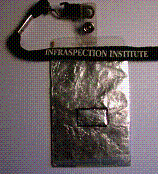


In order to measure reflected temperature, thermographers often utilize a piece of aluminum foil that has been crumpled, re-flattened, and wrapped around a piece of cardboard. The crumpling of the aluminum foil creates multiple angles on the foil surface necessary to measure an average reflected temperature which is entered into the radiometer’s computer.

Using a crumpled foil reflector raises a couple of concerns. Firstly, the aluminum foil is conductive and possibly an arc hazard when working near energized electrical equipment. Secondly, the reflector is often thrown away at the end of each job requiring that a new one be made for the next project.

Here is a small and versatile solution that you can add to your tool kit.

  • Cut out a small piece of cardboard the size
    of an ID card
  • Crumple and re-flatten a piece of
    aluminum foil and wrap around the cardboard
  • Acquire a blank ID card holder with a slot for a lanyard holder
  • Cut a small a 1”x 1.5” rectangle in the center of the front face
  • Seal completed reflector into
    ID card holder with crumpled foil visible though rectangular opening
  • Attach a nonconductve safety lanyard to help prevent dropping

This provides a permanent and inexpensive tool for measuring reflected temperature. For safety, do not let this tool hang from around your neck or otherwise dangle from your body. Always keep reflector tool in a secure location that protects the foil surface when not in use.

Tip and images provided by:
Harley Denio, Oregon Infrared
503-628-7212
PO Box 6252
Aloha, Oregon. 97007
www.oregoninfrared.com


June 13, 2005

Sponsored by:


How to Use Spot Size Ratios


With awareness of infrared technology at an all time high, point radiometers have become a common tool in a wide variety of industries. Understanding how to properly apply spot size values is imperative for accurate temperature measurement.

For non-contact radiometers, manufacturers typically supply spot size values. These values are usually expressed as a ratio such as 50:1. Spot size ratios allow one to calculate the minimum target size for a given distance or the maximum distance for a given target size. The formulae for these calculations are as follows:


Distance to Target ÷ Spot Ratio = Minimum Target Size

Example: Using a radiometer with a spot ratio of 50:1, calculate minimum target size at 25" from a target

Solution: 25" ÷ 50 = 0.5"

Target Size x Spot Ratio = Maximum Distance

Example: Using a radiometer with a spot ratio of 50:1, calculate maximum distance for measuring a 1" target

Solution: 1" x 50 = 50"

It should be noted that non-contact radiometers are subject to minimum focus distances. Prior to using the above formulae, ascertain the minimum focus distance for your radiometer. The formulae contained herein are only applicable at or beyond a radiometer¹s minimum focus distance.

Lastly, spot size ratios supplied by manufacturers are frequently quoted at 90% radiance (accuracy) or less. The Guideline for Measuring Distance/Target Size Values for Quantitative Thermal Imaging Cameras provides a simple procedure for accurately calculating spot ratio values for imaging radiometers. To obtain a copy, contact Infraspection Institute at 609-239-4788.


June 20, 2005

Sponsored by:


Verify Proper Temperature Scale


The devil is in the details. One of the details of accurate temperature measurement is ensuring that your imager or software is set to the proper temperature scale.

Nearly all imaging radiometers and infrared imaging software programs allow a user to select temperature measurement scales. Selection of desired temperature scale is usually made via hot keys or through pull-down or pop-up menu selections. Typical temperature scale choices include Celsius or Fahrenheit.

Frequently, imaging radiometers and software are programmed to initialize with specific settings including temperature scale. Some models may be programmed to initialize with user-defined settings each time they are started. Depending upon system design, these settings may be corrupted over time, or be lost when an internal battery dies or an imager is serviced by the manufacturer.

Because of the significant difference in Fahrenheit and Celsius scales, it is imperative that a thermographer check his/her imager or software for proper scale prior to, and during each use. This is especially true in facilities where several thermographers share an infrared imager and/or software or where multiple applications are performed using the same equipment. Utilizing an incorrect temperature scale can lead to misdiagnosis of problems or assigning an inappropriate repair priority.

The Guideline for Infrared Inspection of Electrical and Mechanical Systems provides temperature limits and several methods for assigning repair priorities to operating electrical and mechanical equipment. To obtain a copy of the Guideline, contact Infraspection Institute at 609-239-4788.


June 27, 2005

Sponsored by:


Incidental Finds


The paths of thermographers can lead in many directions within the course of a single day. Whether inspecting equipment in accordance with an established route or trying to find the shortest way to the next piece of equipment, we may pass by numerous pieces of equipment. Some might be familiar; others might be an encounter of the first kind. In addition to our thermal imaging, we maintian a sharp eye for visual anomalies as well.

In the routes that my partner and I complete on a daily basis, there are numerous pieces of equipment that we pass by that are not part of our schedule. Over time we have learned to be sensitive to things that are out of the ordinary. Remember the old railroad warning: “Stop, Look, and Listen”? The stop part applies to the scanner but the assistant should be in the look and listen mode observing not only the item(s) scanned, but also the surrounding environment.

On many occasions we have found exceptions that do not pertain to our field; nevertheless, we make a point to record them and advise appropriate personnel. We have even gone so far as to generate what we call an “incidental file.” Whenever we come across one of these “incidentals” we’ll snap a picture, notify the right person(s) about what we saw or heard, and then place the info into our incidental folder.

Having a record of these kind of finds is good PR and helps in selling your services, and it may help to prevent a catastrophic event that otherwise might have gone unnoticed.

Submitted by

John Pavlic
General Motors Lordstown Metal Center
Warren, OH

 
July 4, 2005

Sponsored by:


Four Steps to Solving Problems


Solving problems is a constant challenge for most managers. The effectiveness of a manager is directly tied to their ability to accurately define a problem and find the most effective solution. This week’s Tip discusses a simple and proven method for solving even the toughest problems.

Like any project, problem solving involves a series of steps. When completed, the following simple steps should provide an effective solution to nearly any problem. Be certain to complete the steps in order before advancing to the next step.

Step 1: Define the Problem. This is often the most difficult part of solving any problem. Without an accurate problem definition, we cannot begin to find an appropriate solution. When defining a problem, keep it simple and direct, limiting your description to 10 words or less. Once you are certain that your problem definition is accurate, proceed to Step 2.

Step 2: Outline Possible Solutions. Make a list of all possible solutions to the problem you’ve defined. Feel free to brainstorm and let your imagination run free. This is a step for gathering ideas – not for being critical. When appropriate, be sure to seek the input of others.

Step 3: Determine the Best Solution. Drawing from the list generated in Step 2, select the best possible solution to the problem.

Step 4: Implement Your Best Solution. Be sure to monitor the problem and your implemented solution for its effectiveness. If your chosen solution is ineffective, return to Step 3 for an alternate idea.


July 11, 2005

Sponsored by:


Infrared Inspection
of Ballasted Roofing Systems


Infrared inspections can help to detect latent moisture within smooth or gravel-surfaced insulated roofing systems. For roofs covered with high-density ballast or pavers, other forms of non-destructive testing such as capacitance or nuclear gauge testing may provide better results.

For infrared inspections performed during post-sunset hours from the exterior of a building, the collection of accurate infrared data is highly dependent upon roof construction. Applicable roof construction is as follows: Built-up or single-ply membrane installed over, and in continuous contact with, a layer of insulation or an insulating deck. Roof may be smooth, granule-surfaced or gravel-surfaced. If gravel-surfaced, stones should be pea sized or smaller with a thickness of less than one inch.

Roofs covered with concrete pavers or river washed ballast (walnut-sized or larger rock) are not candidates for an accurate infrared inspection. In general, the presence of ballast materials will mask the small temperature differentials associated with latent moisture since they are capable of absorbing large amounts of solar energy during daylight hours.

For some ballasted roofs, it may be possible to detect limited thermal patterns associated with latent moisture; however, this is highly dependent upon roof construction, ballast thickness and density, and local weather conditions. In most cases, the presence of ballast will prevent a thermographer from accurately detecting thermal patterns associated with latent moisture.

For ballasted roofs, it is often prudent to utilize either a capacitance or nuclear gauge instead of thermal imaging. In the hands of a competent technician, these technologies will usually provide more accurate data for detecting evidence of latent moisture within ballasted roofing systems.


July 18, 2005

Sponsored by:


Understanding Electrical Arc Flash


According to the National Fire Protection Association (NFPA), an arc flash is “a dangerous condition associated with the release of energy caused by an electric arc.” Explosions associated with arc flash can cause severe burns, injuries and/or death. Understanding arc flash is the first step to guarding against it.

Often, the most serious injuries associated with electrical accidents are caused by the effects of arc flash, not electrocution. When an arc flash occurs, tremendous amounts of energy are instantaneously released creating the potential for serious or fatal injuries. Among the most dangerous conditions are:

Radiant Heat: Temperatures associated with arc flash can exceed 35,000º F at the arc source. This temperature is nearly four times the temperature of the Sun! At these temperatures, matter instantaneously vaporizes.

Fire: A conductive-plasma fireball can develop during an arc flash. Fatal burns may occur at distances of more than 10 feet from the source of the flash. In addition to burns, flammable clothing may ignite.

Arc Blast: The high temperatures associated with arc flash rapidly heat the surrounding air causing a high-pressure wave or blast. Injuries associated with blast include falls, concussions and hearing damage.

Flying Objects: Flying debris created by damaged components can also cause serious injury. In the heat of an arc flash, copper can expand by a factor of 67,000 times as it vaporizes. Shrapnel and molten metal can cause injuries at significant distances from an arc source.

In the case of arc flash, an ounce of prevention is worth a ton of cure. In future Tips of the Week, we will continue to cover the topic of arc flash and how to protect against it.


July 25, 2005

Sponsored by:


Heat Stress & the Human Body


For many, the peak of Summer brings high temperatures to the workplace. For others, high temperatures in the workplace are an everyday occurrence. Understanding heat stress and its attendant safety challenges is crucial for those working in hot environments.

What is heat stress?

Heat stress is a physical hazard. It is caused by environmental conditions and results in the breakdown of the human thermal regulating system.

What are the symptoms of heat stress?

There are various degrees of heat stress. Each has its own unique symptoms. The most common form of heat stress is heat exhaustion. Symptoms of heat exhaustion include dizziness, confusion, headaches, upset stomach, weakness, decreased urine output, dark-colored urine, fainting, and pale clammy skin.

What do I do If I think I am experiencing some form of heat stress?

Act immediately –

  • Advise a co-worker that you do not feel well
  • Move to an area away from the hot environment
  • Seek shade and cooler temperatures
  • Drink water (1 – 8 oz. cup every 15 minutes) unless sick to the stomach
  • Have someone stay with you until you feel better

What should I think about before working in a hot environment?

Before working in a hot environment, consider the type of work to be performed, duration of time to be spent in hot areas, level of physical activity, and other nearby hazards. Always use appropriate PPE and work together as a team.

Tip provided by Conoco Phillips
www.conocophillips.com


August 1, 2005

Sponsored by:


Heat Stress & Hydration


An ounce of prevention is worth a pound of cure. In last week’s Tip, we covered the topic of heat stress, its symptoms, and treatment. This Tip focuses on the importance of hydration as a preventive measure.

What is heat stress?

Heat stress is a physical hazard. It is caused by environmental conditions and results in the breakdown of the human thermal regulating system. If you work or play in hot environments, your body needs a lot more water than you might think.

What is hydration?

Hydration is the process of adding water. Our bodies need water to do many things. In hot environments we need large quantities of water to help keep our bodies cooled to a temperature that allows them to function properly. Heat stress becomes a health and safety concern when the volume of water we need to function drops below the level necessary to maintain homeostasis. We call this low water condition dehydration or under-hydration. The average person is 7% under-hydrated.

How can I avoid being under-hydrated?

Developing the habit of drinking water at routine intervals. One 8 oz. cup every hour on hot days will assure proper hydration.

How will I know if I am properly hydrated?

Check the color of your urine. You are properly hydrated if your urine is clear, copious in volume, and light yellow in color.

What are the benefits of proper hydration?

Staying properly hydrated will help to avoid heat stress and may increase your energy level. For every 1% under-hydration, you lose 5% of your energy potential.

Tip provided by Conoco Phillips
www.conocophillips.com


August 8, 2005

Sponsored by:


Understanding Electrical Arc Flash


According to the National Fire Protection Association (NFPA), an arc flash is “a dangerous condition associated with the release of energy caused by an electric arc.” Explosions associated with arc flash can cause severe burns, injuries and/or death. Understanding arc flash is the first step to guarding against it.

Often, the most serious injuries associated with electrical accidents are caused by the effects of arc flash, not electrocution. When an arc flash occurs, tremendous amounts of energy are instantaneously released creating the potential for serious or fatal injuries. Among the most dangerous conditions are:

Radiant Heat: Temperatures associated with arc flash can exceed 35,000º F at the arc source. This temperature is nearly four times the temperature of the Sun! At these temperatures, matter instantaneously vaporizes.

Fire: A conductive-plasma fireball can develop during an arc flash. Fatal burns may occur at distances of more than 10 feet from the source of the flash. In addition to burns, flammable clothing may ignite.

Arc Blast: The high temperatures associated with arc flash rapidly heat the surrounding air causing a high-pressure wave or blast. Injuries associated with blast include falls, concussions and hearing damage.

Flying Objects: Flying debris created by damaged components can also cause serious injury. In the heat of an arc flash, copper can expand by a factor of 67,000 times as it vaporizes. Shrapnel and molten metal can cause injuries at significant distances from an arc source.

In the case of arc flash, an ounce of prevention is worth a ton of cure. In future Tips of the Week, we will continue to cover the topic of arc flash and how to protect against it.


August 15, 2005

Sponsored by:


The Best Recommendation


As part of their infrared inspection reports, thermographers frequently include exception diagnoses along with recommendations for repair. In this Tip, we offer our suggestion for the only recommendation a thermographer will ever need.

When used as a tool for Preventive/Predictive Maintenance, thermography can detect and document evidence of thermal patterns and temperatures across the surface of an object. The presence of inexplicable thermal anomalies is often indicative of incipient failures within inspected systems and structures. Because thermography alone cannot determine the cause of an exception, other diagnostic tools must be employed to determine the cause of observed exceptions.

Although thermography is inconclusive, thermographers frequently provide opinions as to the cause of exceptions without having the benefit of confirming test information. Such opinions are frequently accompanied by elaborate recommendations for repair. When such observations/recommendations are incorrect, they can cause repair efforts to be misdirected.

Unless a thermographer has performed, or has access to, confirming tests, providing opinions regarding the cause of exceptions and subsequent recommendations for repair is unwise. When confirming test data are unavailable, a prudent thermographer should make only one simple recommendation: “Investigate and perform appropriate repair”.

This simple recommendation can be applied to any thermographic inspection and serves to avoid unnecessary liability by eliminating guesses and sticking to facts. For more information on infrared training or standards for performing infrared inspections, contact Infraspection Institute at 609-239-4788 or visit us online at www.infraspection.com.


August 23, 2005

Sponsored by:


Normal Hot Spots in Electrical Systems


In general, hot spots within electrical systems are indicative of problems such as loose connections or overloaded circuits. For some electrical components, high temperature operation is normal and an infrared imager can be used to help ensure that these devices are functioning.

During a routine infrared inspection of electrical distribution systems, similar components under similar load are compared to each other. Items appearing inexplicably hot are reported as exceptions to be further investigated and appropriately repaired. For components that normally operate at elevated or high temperature, a lack of heat may be indicative of an exception.

Capacitors used for power factor correction are good examples of components that are normally warm. Properly functioning capacitors should operate above ambient temperature and their casings should be uniform in temperature when compared to similar units under similar load.

Thermal overload relays are found in many motor controllers. The elements of these relays, often called heaters, may operate at high temperature when the circuit is under load. When compared to adjacent phases, these elements should be similar in temperature with no pronounced hot spots.

Electric strip heaters are used to control humidity within switchgear enclosures. Switchgear heaters usually operate at very high temperatures and their operation can easily be verified with an infrared imager. Cold strip heaters may be indicative of a failed element, improper control settings, or a de-energized control circuit.

The above are just three examples where elevated temperatures are normal. Thermographers should always be on the lookout for cold spots that may be indicative of problems in addition to hot spots traditionally associated with exceptions.


August 29, 2005

Sponsored by:


Begin With the End in Mind


“Begin with the end in mind” is a frequent quotation from Stephen Covey’s bestselling book, The 7 Habits of Highly Effective People. Applying this principle can have a dramatic impact on many things including an infrared inspection program.

Prior to underatking any task or project, it is important to have a clear understanding of what the final outcome should be. With this vision in mind, one is able to gauge the effectiveness of their efforts in achieving goals. By beginning with the end in mind, one knows what the goals are and can help chart a course of action that leads directy to these goals.

Building an infrared inspection program is like a construction project. You need to have a clear understanding of what you desire when construction is completed. When starting an infrared inspection program, decide what you want from your program. This is best done by asking yourself the following questions:

  • What is the role of thermography – PPM, PdM, Q/A or Condition Assessment?
  • Which systems/equipment do I want to inspect?
  • How will thermorgraphy improve operations – decrease unscheduled downtime, improve product quality, reduce production losses?
  • What data are available for measuring the program’s effectiveness?

Once these questions have been answered, one can begin to set up an infrared inspection program with necessary equipment, staff and support personnel. By beginning with the end in mind, an infrared inspection program is more likely to succeed by providing value and producing measureable results.


September 5, 2005

Sponsored by:


Is Distance Learning Right For You?


Recent advancements in technology are reshaping traditional approaches to education. Students are now able to study a wide variety of subjects, including thermography, from virtually anywhere in the world.

Distance learning may be defined as any situation where the student and the instructor are in physically separate locations. Distance instruction may be live or pre-recorded and can be delivered via video presentations, remote teleconferencing, and web-based presentations.

Distance learning provides several advantages over the traditional classroom setting. Chief among these are the elimination of travel costs, 24 hour availability, and increased convenience in scheduling. The availability of Distance Learning courses for thermography is particularly beneficial to thermographers with hectic schedules.

When selecting Distance Learning courses for thermography, be sure to determine the following:

  • How and when is course delivered
  • Length of course and curriculum
  • What standards does course curriculum conform to
  • Are experienced instructors available to answer questions
  • Does course qualify toward thermographer certification
  • Experience of training firm in providing thermographic instruction

Infraspection Institute offers a wide variety of Distance Learning courses for thermography. Courses include: Certification Prep, Applications and Industry-Specific Courses. All courses are ASNT compliant and are taught by Level III Infraspection Institute Certified Infrared Thermographers® each having over 20 years experience. For more information or to register for a course call us at
609-239-4788 or visit us online at:

"http://www.infraspection.com/courses_distance_learning_general.html"


September 12, 2005

Sponsored by:


Understanding Emissivity


Emissivity refers to an object’s ability to radiate infrared energy. Because infrared instruments measure radiant energy, it is imperative for a thermographer to understand emissivity and how it can vary.

All objects above 0 Kelvin radiate infrared energy. The amount of energy radiated is dependent upon an object’s temperature and emittance. Increases in temperature and/or emittance will increase the amount of infrared energy radiated.

Although many equate emissivity to values published in emittance tables, emissivity is a dynamic characteristic and is influenced by several factors. Among these are:

Wavelength - For most objects, emissivity varies with wavelength.

Object Temperature – Changes in object temperature cause changes in Emissivity
For clean metals, E increases with temperature rise
For dielectrics, E decreases with temperature rise

Viewing Angle – Imaging at angles other than perpendicular causes changes in Emissivity

Target Geometry – Target shape affects Emissivity. Compared to a flat surface,
Concave shape increases E
Convex shape decreases E

Surface Condition – Surface roughness, texture, or condition (dirt, oxidation or paint) can significantly affect Emissivity

Although thermographers frequently obtain emittance values from published tables, this practice can introduce significant temperature measurement errors since emittance tables cannot account for several of the above factors. Because of this, calculating emittance with one’s thermal imager will help to ensure measurement accuracy.

A simple procedure for calculating emittance may be found in the Guideline for Measuring and Compensating for Reflected Temperature, Emittance, & Transmittance available from Infraspection Institute. For more information or to place an order, call 609-239-4788 or visit us online at www.infraspection.com.


September 19, 2005

Sponsored by:


How to Deal With Emittance


The perpetual question among those using radiometric equipment is, “What emittance value should I use?” In this Tip, we address several options for providing emittance values.

Emittance is a numerical value between 0 and 1.0 indicating an object’s relative ability to radiate infrared energy. Most radiometers allow the user to input emittance values into the radiometer’s computer. Utilizing correct emittance values is imperative for accurate non-contact temperature measurements.

When determining emittance values for a target, there are five accepted ways to obtain an emittance value. These methods are listed below in order of increasing complexity and accuracy.

  • Use General Default Values
    • Organics are generally > 0.80
      Metals can vary widely from < 0.1 to > 0.90
  • Use Emittance Tables
    • Be certain to use tables that match your radiometers spectral response and your target’s temperature.
  • Estimate Emittance
    • Choose representative sample and test for emittance value. Use these values whenever similar object is encountered in the future.
  • Modify Surface to a Known Emittance Value
    • Use tape, paint, or powder with known E. Prior to modifying any surface, be certain it is safe to do so.
  • Measure Emittance Value
    • Use subject radiometer to measure target E value. This practice is preferred as it provides the most accurate emittance values.

The procedure for measuring emittance values is described in detail in the Guideline for Measuring and Compensating for Reflected Temperature, Emittance, & Transmittance available from Infraspection Institute. For more information or to order a copy, call 609-239-4788 or visit us online at www.infraspection.com.


September 26, 2005

Sponsored by:


How to Calculate Emittance


Utilizing correct emittance values is imperative for accurate non-contact temperature measurements. Knowing how to accurately calculate emittance values can help to ensure the accuracy of infrared temperature measurements.

Although thermographers frequently obtain emittance values from published tables, this practice can introduce significant errors. Following the procedure listed below, it is possible to accurately calculate the E value of an object.

Equipment Required:

1. Calibrated imaging radiometer with a computer that allows thermographer to input Reflected Temperature and Emittance values

2. Natural or induced means of heating/cooling target to a stable temperature at least 10ºC above/below ambient temperature

3. Calibrated contact thermometer

Method:

1. Place imaging radiometer at desired distance from heated/cooled target. Be certain that target is larger than imager’s spot measurement area. Aim and focus imager on target

2. Measure and compensate for Reflected Temperature

3. Place imager crosshairs on target

4. Use contact thermometer to measure target temperature at location of imager crosshairs. Remove contact thermometer

5. Without moving imager, adjust E control until observed temperature matches value obtained in Step 4 above. The displayed E value is the Emittance value for this target with this imaging radiometer. For greatest accuracy, repeat above three times and average the results.

Note: This procedure requires contact with the object being measured. Be certain to observe all necessary safety precautions prior to making contact with target.

The above procedure is described in detail in the Guideline for Measuring and Compensating for Reflected Temperature, Emittance, & Transmittance available from Infraspection Institute. For more information or to place an order, call 609-239-4788 or visit us online at www.infraspection.com.


October 3, 2005

Sponsored by:


When, Why and How to Use
Heat Transfer Analysis


Thermographers routinely observe thermal patterns and measure temperatures across the surface of objects. Understanding heat transfer can greatly enhance one’s ability to diagnose observed thermal patterns and knowledge of how and when infrared inspections should be performed.

By calculating the heat transfer characteristics of the system being observed, a thermographer can increase his/her understanding of the information that thermal imaging is providing. The thermographer can also benefit by understanding what may need to be done to the subject system in order to generate a thermal signature for the features of interest.

For active infrared thermography, common in NDT examinations, heat transfer analysis will indicate where and how much heat to apply, for what amount of time, and the appropriate time for imaging. For systems with simple geometry and steady state conditions or simple time transients, heat transfer can be calculated manually

For complex systems, finite element analysis (FEA) provides a more powerful approach. FEA allows modeling of complex geometry and complex time relationships and boundary conditions. FEA can provide clear results that enable thermographers to be more efficient and profitable while expanding their range of applications.

FEA based heat transfer analysis can handle convection, conduction, and radiation based heat transfer and also extends to include fluid flow applications. Having a third party provide this analysis is often the best alternative. This can be someone who is in-house in a large company or an outside source such as a consulting firm.


Tip submitted by Jack Kleinfeld, P. E.
Kleinfeld Technical Services, Inc.
" We Know IR and Do FEA."SM


Jack Kleinfeld


October 10, 2005

Sponsored by:


SIC and NAICS Codes for Thermography


SIC and NAICS codes are numerical codes used to categorize a wide variety of products and services. Knowing the proper codes can be helpful in preparing contract documents, searching databases, or completing forms and reports where such numbers are required.

Standard Industrial Classification (SIC ) are numerical codes designed by the U.S. Government in order to create uniform descriptions of business establishments. SIC codes can be used to search databases and/or to identify companies that produce specific products or services.

The SIC code for Infrared Inspection Services is: 8734-15. This is a subset of the heading, Testing Laboratories.

Other SIC codes that may be of interest to thermographers are as follows:

Electrical Power Systems - Maintenance: 7389-43

Roofing Service Consultants: 8748-09

In 1997, the North American Industry Classification System (NAICS) replaced the SIC system. The NAICS was developed jointly by the U.S., Canada, and Mexico to provide new comparability in statistics about business activity across North America.

In the 2002 version of the NAICS, Infrared Inspection Services are classified under code 541380, Testing Laboratories. As with SIC codes, a company’s classification may include other categories depending upon a company’s core business and/or future changes to existing NAICS codes.

For more information on NAICS codes, visit the U.S. Census Bureau.


October 17, 2005

Sponsored by:


Calculating the Value of an Electrical Hotspot


What is the financial liability of a hotspot within an electrical system? Probably less than you think since electrical hotspots waste surprisingly little energy even when operating at high temperatures.

Over time, many have stated that the cost of infrared inspections can be justified through the detection and subsequent repair of hotspots associated with loose/deteriorated electrical connections. Although these types of defects can produce temperature rises of hundreds of degrees, the amount of energy wasted in the form of excess heat is often surprisingly small.

When detected in their formative stages, loose/deteriorated connections may contribute to only a few watts of energy loss. Even large temperature rises associated with significantly degraded connections will usually produce energy losses of less than 100 watts. We can calculate the financial impact of such an exception as follows:

0.1 kw x 24 hours = 2.4 kwh per day

2.4 kwh x 365 days per year = 876 kwh per year

876 kwh per year x $0.14 per kwh = $122.64 per year

It is important to note the above illustration is for an extreme hotspot operating undetected 24 hours per day for an entire year. While the above potential savings may seem significant, it would be hard to justify the expense of an infrared inspection program based upon energy savings alone. Justification would be even harder if the dissipated energy were only a few watts.

The real value of information obtained from infrared inspections comes from reducing unscheduled downtime, increasing reliability, improving safety, and avoiding losses associated with catastrophic failure.


October 24, 2005

Sponsored by:

Brady Infrared Inspections, Inc.

935 Pine Castle Court
Stuart, FL 34996

www.bradyinfrared.com


The Power of Inductive Heating


The magnitude and intensity of inductive heating should not be underestimated when performing infrared inspections of electrical switchgear. Inductive heating is derived from the proximal interaction of non-current carrying devices with the magnetic field around energized conductors that are under load.

Inductive heating affects ferrous metals and causes inexplicable heating of non-current carrying components. The intensity of heating is a function of the amount of current passing through the conductor and rather than the voltage class. In some cases, the affected components can reach temperatures in excess of several hundred degrees.

During a recent inspection at a power generation plant, two examples of inductive heating where observed near the plant’s step-up transformers.  Images captured showed intense heating on a non-current carrying support pole and bus transition box, both of which were close to iso-phase bus entering a13kV to 230kV step-up transformer.  Temperatures documented on these devices were in excess of 400°F.  Being the starting point of transmission service, a heavy current load would be expected on energized equipment.


Often, engineering designs on switchgear enclosures and other electrical equipment do not take into consideration the interaction of non-current carrying ferrous devices within electro-magnetic fields.  In some cases, these situations can pose safety hazards when the affected component is in contact with combustible materials or heats structures that are accessible to human contact.  When faced with perplexing heat patterns on components that should not be hot, inductive heating may be to blame.


Visit Infraspection Institute Web Site


October 31, 2005

Sponsored by:


Frequency of Infrared Inspections
of Electrical Equipment


“How often should electrical systems be thermographically inspected?” Historically, accepted industry practice has recommended that infrared inspections be performed annually; however, site specific conditions may dictate considerably shorter intervals for some equipment or facilities.

According to the 2002 Edition of NFPA 70B Recommended Practice for Electrical Equipment Maintenance, “Routine infrared inspections of energized electrical systems should be performed annually prior to shutdown. More frequent inspections, for example, quarterly or semiannually, should be performed where warranted by loss experience, installation of new electrical equipment, or changes in environmental, operational, or load conditions.”

Semi-annual infrared inspections may also be prudent where unscheduled outages of electrical equipment could pose significant environmental or safety hazards, or result in catastrophic damage to other systems or components.

Because infrared inspections are only effective when electrical system components are energized, it is imperative to perform infrared inspections when subject equipment is operational. For facilities with seasonal equipment such as heating and cooling systems, it may be necessary to schedule infrared inspections on several different days spread throughout the calendar year.

As always, infrared inspections of electrical systems should only be performed by properly trained and certified thermographers following all appropriate safety precautions. For information on thermographer training and certification or to obtain a copy of the Guideline for Infrared Inspection of Electrical and Mechanical Systems, contact Infraspection Institute at 609-239-4788 or visit us online at: www.infraspection.com.

To obtain a copy of NFPA 70B, contact the National Fire Protection Association at 1-800-344-3555 or visit them online at: www.nfpa.org.


November 7, 2005

Sponsored by:


Gauging When IR Inspection Window Opens/Closes


Solar-driven infrared inspections of insulated structures and roofs must be performed when sufficient Delta T is present. Knowing how to gauge when this window of opportunity is present is critical to the accurate collection of data.

Infrared inspections of structures often utilize solar loading to create temperature differentials necessary for the inspection. Common applications include moisture inspections of roofs and walls, structural inspections of CMU walls, and gauging product levels in tanks and silos. Often, these types of infrared inspections are performed during evening hours following a sunny day while the structure is cooling.

The time frame during which solar-driven infrared inspections may be accurately performed is often referred to as the ‘scanning window’. The scanning window is said to be open when conditions permit the collection of accurate data. A number of interdependent factors will determine when the scanning window opens and closes. These include, but are not limited to: target construction, amount of solar loading, local weather conditions, and imager sensitivity.

To determine when the scanning window opens, a thermographer should initially isolate an area with a small delta T indicative of an exception. For moisture inspections, this might be an area that is confirmed to be minimally wet. Using this area as a benchmark, the thermographer can periodically re-check this area during the inspection to determine if a Delta T remains. In general, the disappearance of a Delta T in the benchmark area will indicate that the scanning window is closing.


November 14, 2005

Sponsored by:


Imager Operational Check Prior to Inspections


Many infrared applications standards require that infrared test equipment be within calibration prior to the conduct of an inspection. Although performing a full calibration on daily basis is impractical, performing some simple operational checks can help to ensure that equipment is functioning properly.

Prior to commencing an infrared inspection, a thermographer should set up his/her equipment by:

  • Checking imager optics for cleanliness
  • Ensuring that batteries are fully charged
  • Inspecting power and video cables/connectors for electrical integrity
  • Allowing imager to stabilize with ambient temperature.

After completing the above, power-up the thermal imager and note that the imager initializes properly. Once the imager has initialized, adjust imager controls to normal temperature range. Focusing on a high emittance target such as a tabletop or a wall covered with latex paint, check the monitor for image clarity. If the image has inexplicably hot or cold pixels, perform a non-uniformity correction.

Once the image appears clear, a small Delta T can be created by placing one’s hand on one of the above high E surfaces for a few seconds. After removing the hand, image this same area and note the thermal pattern and its intensity. With a properly operating thermal imager, the thermal pattern of the hand should be clearly visible and last for at least one minute.

For more information on thermographer training and certification, contact Infraspection Institute at 609-239-4788 or visit us online at www.infraspection.com.


November 21, 2005

Sponsored by:


Infrared Inspections to Detect Latent Moisture


As interest in building remediation has increased, thermography has become a common tool for helping to detect moisture damage. Knowing when and how to conduct an infrared inspection is key to success.

Water infiltration into buildings can have devastating effects on building materials. Left untreated, latent moisture can cause excess energy loss, mold growth and/or structural failure. Latent moisture also causes changes in the thermal capacitance and conductivity of materials.

Prior to performing an infrared inspection, determine the best vantage point for imaging. Insulated roofs and exterior building finishes such as EIFS are traditionally inspected from the exterior of the building. Interior inspections are usually effective when moisture is affecting interior finishes of the building such as drywall. Thermal imaging may not be effective for low emittance targets.

Next, choose an appropriate time to ensure that a detectable Delta T will be present. For roofs and building exteriors, best results are usually obtained during evening hours following a sunny day. As an alternative, inspections may also be performed when there is an inside/outside temperature differential of at least 10Cº. In some cases, inspections performed from the interior may be performed with a smaller Delta T.

Thermal signatures associated with latent moisture will vary with type of building material and the amount of moisture contained therein. Depending upon vantage point and time of inspection, exceptions caused by latent moisture may show as either hot or cold thermal anomalies. These anomalies may be amorphously shaped, mottled, or correspond to the size and shape of absorbent materials. All thermal data should be correlated with invasive testing to ascertain moisture content of inspected areas.


November 28, 2005

Sponsored by:


How Much Certification Do You Need


Certification and levels thereof are one of the most frequently discussed issues in thermography. With few standards addressing certification, purchasers of infrared inspection services and thermographers often ask, “How much certification is necessary?”

Due to a variety of definitions, certification can have different meanings. As it is used in thermography, certification generally means, “to declare something to be true and/or to attest by issuing a certificate to.”

The American Society for Nondestructive Testing document, SNT-TC-1A provides suggested curricula and experience for under the Thermal/Infrared test method. Recommended curricula and the classroom hours are listed below; these should be modified to meet an employer’s needs.

Certification Level
Training Hours
Months Experience
1
32
3
2
66
18
3
66
66

In short, it is up to an employer to determine his/her client’s needs for and to set certification requirements accordingly.

Taken at face value, certification generally indicates one’s level of formal training. This training, combined with experience and knowledge of the system or structure being inspected determine a thermographer’s qualifications.

In a larger sense, certification is a measure of a thermographer’s professional qualifications. It is therefore incumbent on the professional thermographer to achieve the highest level of certification possible. The rewards for doing so are both personal and professional and can provide significant financial and competitive advantages.

Infraspection Institute has been training and certifying professional infrared thermographers since 1980. Our Level I, II, and III Certified Infrared Thermographer® training courses are fully compliant with ASNT and industry standards. Students may choose from open-enrollment and convenient web-based Distance Learning Courses. For more information or to register for a class, call 609-239-4788 or visit us online at www.infraspection.com.


December 12, 2005

Sponsored by:


Ambient Temperature & Radiometer Accuracy


Many who live in cold climates are in the habit of allowing their automobile to warm up before driving. For accurate temperature measurement, one should allow sufficient time for a radiometer to equalize with ambient temperature.

When performing non-contact temperature measurements, many thermographers correct for error sources due to emissivity, reflectivity and transmissivity. One error source that is often ignored is the temperature of the radiometer itself. Depending upon design, radiometer operating temperature can significantly affect measurement accuracy.

Radiometers are calibrated under controlled laboratory conditions at stable ambient temperatures. To help ensure measurement accuracy, quality radiometers are constructed with internal temperature sensors. These sensors allow the radiometer’s firmware to correct for operation at different ambient temperatures.

When performing non-contact temperature measurements, radiometers should always be allowed to stabilize with ambient air temperature. Additionally, one should ensure that the radiometer’s lens is clean and free of condensation.

Infraspection Institute has been training and certifying professional infrared thermographers since 1980. Our Level I, II, and III Certified Infrared Thermographer® training courses are fully compliant with ASNT and industry standards. Students may choose from open-enrollment and convenient web-based Distance Learning Courses. For more information or to register for a class, call 609-239-4788 or visit us online at www.infraspection.com.


December 19, 2005

Sponsored by:


Files Worth Saving


With year-end in sight, many will begin the annual process of clearing out files and getting ready for the upcoming year. In this week’s Tip, we share some thoughts on files that you may wish to keep.

Recently, while cleaning out some old personal files, my family came across a classic Christmas poem that had been transcribed by my grandmother many years ago. The poem titled, “Jest ‘Fore Christmas” is a 19th century Eugene Field poem that recalls simpler times. The poem’s central character is a boy named William. It is likely that this particular work had caught my grandmother’s attention since her husband and oldest son were both named William.

Now as we read the yellowed and fragile notepaper that bears our grandmother’s distinctive handwriting, we can recall many fond memories of her and our family, especially during Christmas.

With the holidays and busy year end schedules upon us once again, we invite you to take the time to make special memories with family and friends and to file them in your heart so that you may easily find them in the future.

As we enjoy this holiday season, we extend a heartfelt Thank You to all of our readers, friends, and associates throughout the world for everything that you do for us all year long. May your holidays be filled with peace and joy and your New Year with good health and happiness.

~ Jim & Chris Seffrin

Jest 'Fore Christmas

by Eugene Field (1850-1895)

Father calls me William, sister calls me Will,
Mother calls me Willie, but the fellers call me Bill!
Mighty glad I ain't a girl---ruther be a boy,
Without them sashes, curls, an' things that 's worn by Fauntleroy!
Love to chawnk green apples an' go swimmin' in the lake---
Hate to take the castor-ile they give for bellyache!
'Most all the time, the whole year round, there ain't no flies on me,
But jest 'fore Christmas I 'm as good as I kin be!

Got a yeller dog named Sport, sick him on the cat;
First thing she knows she doesn't know where she is at!
Got a clipper sled, an' when us kids goes out to slide,
'Long comes the grocery cart, an' we all hook a ride!
But sometimes when the grocery man is worrited an' cross,
He reaches at us with his whip, an' larrups up his hoss,
An' then I laff an' holler, "Oh, ye never teched me!"
But jest 'fore Christmas I 'm as good as I kin be!

Gran'ma says she hopes that when I git to be a man,
I 'll be a missionarer like her oldest brother, Dan,
As was et up by the cannibuls that lives in Ceylon's Isle,
Where every prospeck pleases, an' only man is vile!
But gran'ma she has never been to see a Wild West show,
Nor read the Life of Daniel Boone, or else I guess she 'd know
That Buff'lo Bill an' cowboys is good enough for me!
Excep' jest 'fore Christmas, when I 'm good as I kin be!

And then old Sport he hangs around, so solemnlike an' still,
His eyes they seem a-sayin': "What's the matter, little Bill?"
The old cat sneaks down off her perch an' wonders what's become
Of them two enemies of hern that used to make things hum!
But I am so perlite an' tend so earnestly to biz,
That mother says to father: "How improved our Willie is!"
But father, havin' been a boy hisself, suspicions me
When, jest 'fore Christmas, I 'm as good as I kin be!

For Christmas, with its lots an' lots of candies, cakes, an' toys,
Was made, they say, for proper kids an' not for naughty boys;
So wash yer face an' bresh yer hair, an' mind yer p's and q's,
An' don't bust out yer pantaloons, and don't wear out yer shoes;
Say "Yessum" to the ladies, and "Yessur" to the men,
An' when they 's company, don't pass yer plate for pie again;
But, thinkin' of the things yer 'd like to see upon that tree,
Jest 'fore Christmas be as good as yer kin be!


December 27, 2005

Sponsored by:


Determining Neutral Plane Location


Thermographically detecting air leakage sites within buildings is dependent upon proper site and weather conditions and imaging vantage point. Determining the location of a building’s neutral plane is key to ascertaining the correct vantage point for thermal imaging.

Air leakage can account for significant energy losses within buildings. Such losses occur as unconditioned air moves through the building’s thermal envelope into conditioned spaces. For heated low-rise structures, air typically infiltrates at lower elevations and exfiltrates at higher elevations. Simply defined, the neutral plane is the elevation within the structure where no air leakage occurs since indoor/outdoor air pressure is balanced.

Determining neutral plane location can often be more art than science. Among the many factors that influence the location of the neutral plane are: building construction, building height, inside/outside temperature differential, and the operation of the building's HVAC system. Wind speed and direction can also influence the location of a neutral plane.

To help determine the location of a building’s neutral plane, use your thermal imager to investigate likely air leakage sites such as electrical receptacles on exterior walls. If you detect evidence of air infiltration at these sites, move upward to the next floor of the structure. Once above the neutral plane, evidence of air leakage sites will generally not be thermographically detectable unless a negative pressure is created with a blower door or the building's HVAC system.

Infraspection Institute has been training and certifying infrared thermographers worldwide since 1980. Infrared inspection of building envelopes is covered in depth in all of our Level I training courses. For more information on our Certified Infrared Thermographer® or Distance Learning courses, call us at 609-239-4788 or visit www.infraspection.com.


Legal Disclaimer Site Map