



Jon L. Grossman
Hi-Tech Inspection Services, Inc.
7520 NW 54th StreetMiami, FL 33166 Phone: 305-639-1820 / Fax: 305-639-1928
[wdgpo_plusone show_count=”yes”]
Abstract
For years the pest Management Professional has relied on visual and manual inspections to locate insect pest infestations. As building materials have improved, the ability to locate pest problems has become more difficult since building materials are often able to mask the existence of pest infestation. Additionally, these improved building materials have contributed to the pest problem by providing a convenient food and nesting source.
Within the past five years, the Pest Management Industry has become aware that IR thermography can aid in the detection of pest infestation by detecting evidence of latent moisture within structures. This paper discusses the use of thermal imaging to detect thermal patterns associated with insect infestation, verification of data and special challenges associated with the inspection process.
History
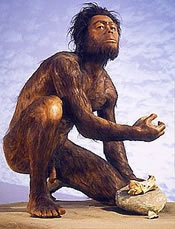 Pest control has been around since before mankind. Initially it was performed by our ancestors who, living in trees or on the ground, continually groomed themselves to be free from insect pests. Fundamentally, it was an activity that relied upon sight. If you could see them you could dispose of them. The evolution of pest control continued in concert with the evolution of man. As the eras moved forward and man evolved into modern man, the activities of pest control also evolved, but not quite at the same pace.
As evolution continued through the stone and tool age, man soon realized the use of a club-like implement or a stone was preferable to the use of his hand or bare foot. It’s a hard act to stomp on a scorpion without getting stung.
 The club evolved to the use of tools. With the abundance ofpests in man’s world, it became a profession, hopefully operated by men who were more skilled and more knowledgeable in the art of locating and disposing of the unwanted pests than our ancestors.
The profession expanded and as man became less tolerant of different types of pests, the skills of the pest control professional also needed to advance.
 Fortunately, the use of chemicals became one of the answers. The killing of pests still relied in part on seeing them, but once seen, the use
  of chemicals was then the answer. Industry brought forth the use of a wide variety of various chemistries that had significant success in the killing of those blasted pests, but unfortunately, some of these chemicals, like DDT, produced unwanted results. Mutations and the disintegration of some of the vital DNA chains were seen as well as gradual pest resistance to various chemicals.
As we moved into the 70’s, the pest population again began to expand. The pest professional however, still relied upon his sight to locate pest infestations. Timeworn basic tools – a prod, now in the form of a screwdriver and a portable light – the flashlight was used to see possible signs of insect pest problems. The pest professional still relied on his basic Rule of Thumb – if he could see ‘em, he could kill ‘em.


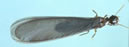
Modern construction materials as well as better construction techniques have provided new forms of harborage and new food sources for the insect pests. The use of slab construction has in one respect made the home stronger and more durable while on the other hand it has helped in hiding entry points that the pests use. Plasterboard or gypsum board has replaced lathe and plaster, providing uniform strength and ease of installation, but unfortunately it offers a great food source for the cellulose eaters such as termites. A good carpenter will, to the naked eye,
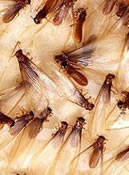
create tight joints and flush fittings, however, hidden behind that paint and stucco are tiny openings perhaps only 1/16” in diameter. These small openings can permit the entry of tiny termite alates that can mature into a termite queen capable of fostering millions of other termites or permit the entry of other insect pests such as carpenter ants. Some pests such as carpenter bees need no man-made or opening created by shrinkage, they create their own entryway by chewing their way into a structure.
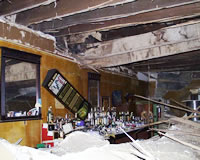
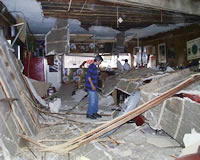
The insect pests live virtually hidden from view and flourish, happily munching away, almost always only to be discovered when they leave a sign of their presence. Perhaps that sign is in the form of fecal droppings, called frass, or perhaps it is only found when the bubbling paint becomes obvious or even more obviously when the floor or ceiling collapses. These types of occurrences are obviously too late to prevent the damage, but provide sufficient evidence for immediate pest control action and possible lawsuits.
 |
 |
|
Above are two views of the Le Dale Hotel and Bar ceiling that collapsed from Formosan termite damage. ~ Courtesy Jack Leonard – New Orleans. |
|
Use of Thermal Imaging as a Tool
About six or seven years ago, a gentlemen involved in the pest control industry asked a vendor who was promoting the use of an IR camera at a trade show if he could find termites with the camera. The gentleman asking the question was Jack Leonard, who was employed by the only publicly funded pest control agency – the New Orleans Mosquito and Termite Control Board (NOMTCB). The vendor was Bob Melia, who was a prime mover in the US Coast Guard’s employment of thermal imaging cameras. And so the saga began. They began testing cameras and various lenses and soon the duo noticed that when they imaged the interior of buildings in New Orleans and found anomalous cooling, there was a correlation between the presence of moisture and the possible presence of insect pests – in their case Formosan termites. They also discovered that when they noted anomalies on wall or wood structures, in many cases the anomalies represented subsurface defects that had a high correlation with damage that had been or was being done within the wood structures, again by termites. In both cases the anomalies were not visible to the naked eye.
With positive result after positive result, and being in a region infested with the very destructive Formosan termite, the use of the IR thermal imaging camera became a key tool in Operation Full Stop (1998 to present), a USDA and US Congress mandated project aimed at containing and treating the Formosan Termite infestation in the Historic New Orleans French Quarter. Today, an IR thermal imaging camera is a tool to be used whenever the NOMTCB does termite pest inspections in New Orleans, and Jack Leonard, though retired, has perhaps more experience than any other professional in termite detection using IR cameras.
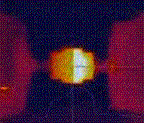 |
The use of the IR camera as a tool in the pest control industry is perhaps somewhat different than, for instance, using the thermal imaging camera for the inspection of electrical circuitry, the inspection of refractories or for the inspection of operating machinery or equipment. In most of these instances, the thermal emissions are of a high temperature and the IR imagery is readily obvious. | 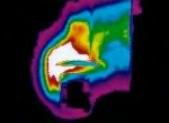 |
|
~ Images courtesy of Jeresy Infrared Consultants.
|
||
The use of the IR camera as a tool in the pest control industry is perhaps somewhat different than, for instance, using the thermal imaging camera for the inspection of electrical circuitry, the inspection of refractories or for the inspection of operating machinery or equipment. In most of these instances, the thermal emissions are of a high temperature and the IR imagery is readily obvious.
On the other hand, inspections utilizing IR imagery in pest control consists almost entirely of low or near ambient temperature emissions with sometimes very subtle changes in imagery. It is not only the
skilled eye of the thermographer, but also an understanding of what the attendant situation might be that aides the thermographer in making proper interpretations and analysis of the IR imagery. Understanding and having knowledge of the primary factors that are associated with some insect pest problems is an absolute requirement. Knowing and understanding other factors that are associated with other pest
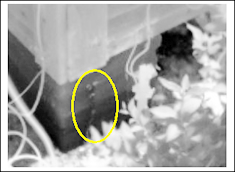
problems such as seasonal and regional nuances also leads to the proper interpretation and analysis of the imagery. Any thermographer providing services in pest control must be aware that in a vast majority of the cases, the anomalies may be very, very small and may be easily overlooked. A typical termite mud tube might be less than 1/4 of an inch wide and may be on the inside of a gypsum wall or hidden in a small crack in brickwork or located inside a concrete block. In addition, an active termite mud tube might contain less than 10% in moisture. Obviously, difficult to see and easily overlooked but a miss, when it comes to pest control, can result in hundreds, thousands or tens of thousands of dollars worth of damage. On the other hand, locating an infestation of termites in its early stages might save thousands or even tens of thousands of dollars worth of damage as many a lawsuit will attest. In addition, locating toxic black and other molds may forestall sickness and even death.
As an example, let’s assume that we are inspecting a house for insect pests. Assume the house is air conditioned with reverse cycle heating, has wood flooring, is fully insulated, and is in a tropical climate alongside a stream feeding into a nearby lake. The house has a 15-year-old tile roof and is surrounded by excellent landscaping with lots of shade trees providing harborage for squirrels, birds and the usual array of neighboring possums, raccoons, rats and mice which the homeowners dearly love; well, maybe not the possums, rats and mice. The house has a brick and stucco face over highly efficient EIFS (foamed sheet) insulation and has a basement, a few crawl spaces under the porches and an attic. Really a beautiful house.
Welcome to the pest inspectors nightmare.
Let us further assume that when we arrive we have good conditions, not perfect, but good; it’s 90ºF outside and with the A/C on it’s 78ºF inside. Cranking down the air will give us better conditions, so we set the temperature to 65ºF as we go about our business. Now we are ready to begin.
Initially we will make a sketch of the layout of the house, make some approximate dimensional notes, note the orientation to the compass, move to the outside, check the sun and wind conditions and take some digital pictures.
The typical inspector in the pest control industry of today is typically armed with advanced tools of his trade – a flashlight and a screwdriver. With these technical tools, today’s pest inspector looks for visual signs of a pest infestation.
On the exterior of the house, the pest inspector is typically looking for things such as peeling paint, signs of cracking, signs of moisture, soil against the side of the house and other signs that might signal conducive areas for pest infestation or other signs of abnormalities. Unfortunately, the average pest inspector might miss more than he finds. It may be as simple as not being able to see that problem up into the eaves because it’s too high to visualize or that it is too well hidden from the naked eye or perhaps when he is doing his inspection, he left the motor running in his truck, simply making sure that his customer, the seller’s real estate agent, is kept happy by a clean inspection. (No inference intended.)
 |
 |
|
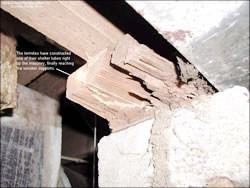
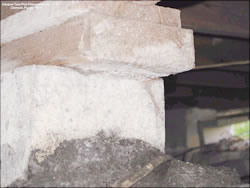
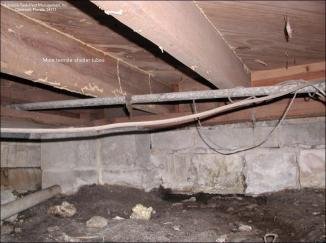
Crawl space area visually showing presence of termite mud tubes both of active and inactive nature. Courtesy – Advance Tech Pest Management, Clermont, FL. |
|
In the interior of the house, the pest inspector again will be looking for similar signs. He will also look for insect wings, frass (fecal droppings, aka poop) and will do a lot of tapping with the butt end of the screwdriver in likely areas such as door jams, sill plates, widow sills, floor boards, etc. always hoping to hear a hollow sound that might signal deterioration. Year after year, the pest inspectors are called to sites that have had swarming termites and are unable to find the exact location of the infestation. If there is fraz or pellet evidence, some inspectors can tell what type of termite, borer or even what type of ant has caused the problem. If any of these elements are located, the pest inspector, now alert to the possibility of a payday, makes every effort to locate the pest infestation itself. If he is able to do that, he will most probably cinch the deal and ring the cash register. Knowing what types of bugs are in the area and having a gift of the gab, he may either end up selling a fumigation job or miss getting the job because he could not convince the homeowner of the location of the pesky critters.
Detection of Thermal Patterns Associated with Pest Infestation
The IR camera can best be classified for the pest management professional as a gross overview inspection tool. As in most thermal imaging inspections, the IR camera is but one tool in the inspection process. Thermal imaging permits a skilled operator to rapidly inspect a site. At the outset, there are two (2) elements a trained inspector will be looking for: 1) areas exhibiting anomalous cooling behavior usually associated with the presence of moisture, and 2) the presence of subsurface defects. In addition, thermal imaging can play a significant role in other phases of pest inspection such as resultant treatment or remediation.
As mentioned above, one of the major signs of a possible pest infestation is latent moisture. That moisture, in the case of a pest infestation, is a critical element needed to support the life of the insect pest. Some insect pests can live on as little as 2-5% moisture, while others, especially where there is an above ground colony, may require significantly more. Therefore, one of the primary objectives in any thermal inspection process is to locate evidence of the thermal patterns that exhibit anomalous cooling which in many cases indicates the presence of latent moisture.
Moisture
Remember the house we are inspecting. It is near a lake and has a nearby stream. The climate is warm. The surrounding area is obviously moist. Prime area for all sorts of critters. The locations of these signs on the outside or underneath the structure may be anywhere. Any and all locations need to be charted and checked. Additionally, the presence of moisture on the outside may or may not evidence itself on the inside of the
 |
 |
|
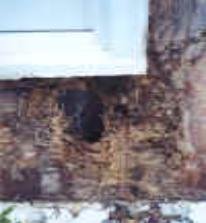
Water and termite damage at windowsill with
EIFS insulation (EIFS removed) |
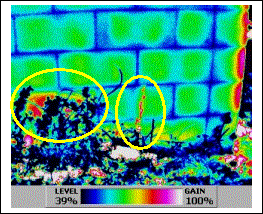
Active termite tubes on cement blocks. Courtesy Jack Leonard- New Orleans. |
structure. Beginning with each side of the building and taking into account the position of the sun and the wind factors, close inspection of the areas in contact with the ground, behind the plant beds and other areas where plants and/or trees touch the structure, the brickwork and the areas where the stucco covers the EIFS and in the cracks and voids of the tile roof are prime areas of focus. The anomalies may
be minute in nature, slight evidence of dirt in the cracks of the brickwork, minor shading in the stucco areas, around window sills, doorways and door entryways. Remember it was said that the nightmare was beginning. A good knowledge of historical pest problems enables the pest thermographer to know that stucco over EIFS is prone to holding moisture and can act as a harborage for insect pests. So if the presence of EIFS or similar products is known, extra diligence is required in the inspection process.
All porches, verandas, lattices, sole and sill plates and even the outside fence and fence posts need to be scanned. The crawlspace will need to be entered and all the brickwork, piers, beams, pilings and even the rubble stone supports need to be examined and scanned.
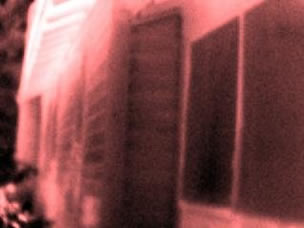
The following are examples of some recent images that exemplify some issues to be looked for:
 |
 |
|
Damage in eaves area – Orlando FL.
|
Anomalous cooling in exterior wall area,
no gutters to permit runoff – Orlando, FL. |

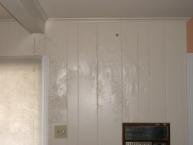
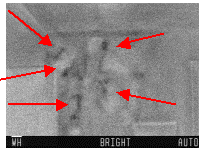
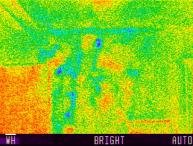
The presence of moisture on the inside may also be anywhere, the basement, the crawlspace, baseboards, walls, ceilings, under floor tile or marble tile, under the showers or the bathtub, in the laundry room or in the attic. The complete structure requires scanning, all closets, cabinet areas, laundry and utility areas, including electrical panels, for signs of anomalies. Once an anomaly is located, notation should be made and documented not only with IR images but also with digital images.
 |
 |
 |
|
Digital, grayscale and colorized images of wall area in house with termite activity behind wall. – Jack Leonard New Orleans |
||
 |
 |
 |
|
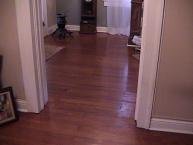
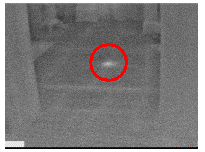
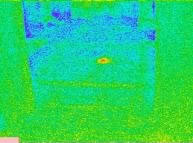
Digital, grayscale and colorized images of floor area in house with termite activity. – Jack Leonard New Orleans. |
||
 |
 |
 |
|
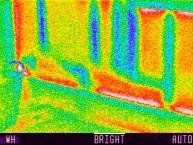
Digital, grayscale and colorized image of wall area with active termite activity. – Jack Leonard New Orleans. |
||
 |
 |
 |
|
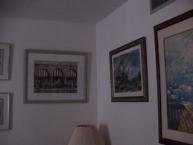
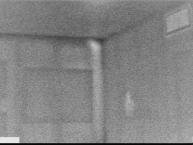
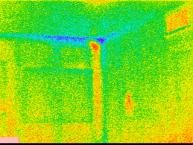
Digital, grayscale and colorized image of wall area with active termite activity. – Michael Potter, PhD. Lex.,KY. |
||
 |
 |
|
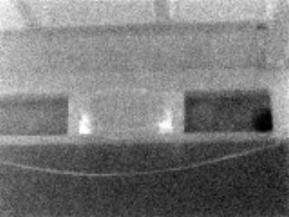
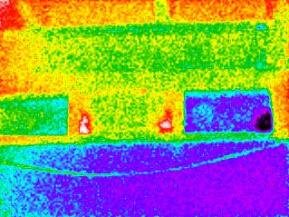
Grayscale and colorized images of basement box header with termite activity. – Michael Potter, PhD. Lex.,KY. |
|
It is imperative to understand and learn the basic patterns of moisture that may be indicative of an insect pest problem. As stated above, termite mud tubes are commonly less than 1/4 inch in width and may be hidden within a wall structure making it very difficult to spot mud tube activity. In addition, mud tubes are the highways used by the subterranean termite. Since that variety usually lives in the ground, they must find some means to enter into any given structure. That entry point may be where a pipe enters the building, where soil is against the side of a structure providing access to the side of a structure above its slab or even from a tree leaning up or growing against a structure providing a convenient above ground entry point. Again, the mud tubes provide the highway from the ground and offer the opportunity to discover their presence, but once located, you need to then determine where that highway is going and what the extent of infestation is. The highway is usually going toward a source of cellulose – the main dietary requirement of any termite. Wood framing, sill plates, beams, wall studs, cabinetry and even the paper on the backside of the gypsum board all can fill the dietary needs of the termite. A typical house could provide sufficient food to support millions of termites for many years.
Usually, the mud tubes of termites are two-laned highways. The trailers are the termites carrying the food from the feeding location to the colony in the ground that then return to the feeding area passing each other as they go. They carry the moisture from the ground up into the tubes to keep them moist. Occasionally, the termites are lucky enough to locate a source of moisture within the structure that is continuous and sufficient to support the needs of a colony. The termites may then set up an above ground colony that is very close to their food source. And assuming that the structure is heated or in a warm climate, it can provide optimal conditions on a year-round basis to support a termite infestation.
 |
 |
 |
|
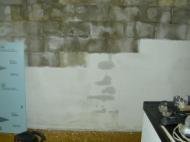
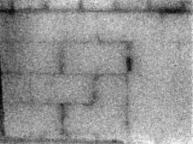
Digital, grayscale and colorized images of inside basement wall area with termite activity. – Michael Potter, PhD. Lex.,KY. |
||
 |
 |
|
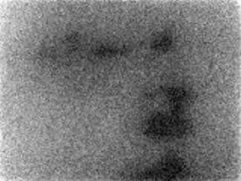
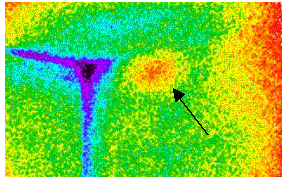
Grayscale and colorized images of 2 separate wall areas in house – Michael Potter, PhD. Lex.,KY. |
|
Mold
Moisture may also be an indicator of the presence of another problem – fungi or mold. Indoor mold has been characterized in recent years as the indoor killer. It is currently considered the big threat to buildings and their occupants and is considered to be a responsible factor in sick building syndrome. In some states, like Florida, mold falls within the pest control category. Not all molds are dangerous, however all molds should be treated with the same respect due to potential health issues. Any presence of latent moisture both on surfaces and in subsurfaces discovered during an IR inspection are important indicators that need to be thoroughly investigated.
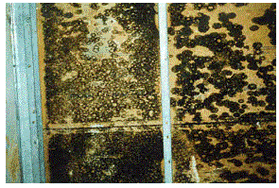
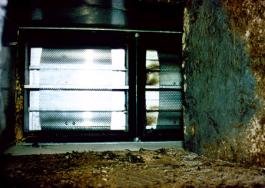
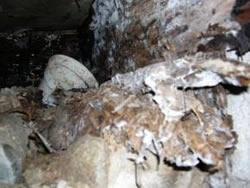
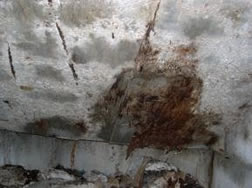
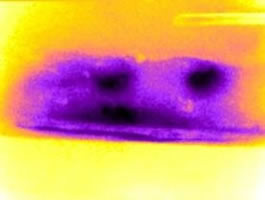
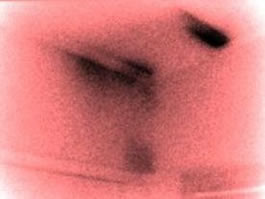
The following images are examples of visible mold as well as IR images of locations were mold was discovered after further examination of an active moist area.
 |
 |
|
Stachybotrys chartarum mold in bathroom wall. |
Mold in HVAC ductwork.
|
 |
 |
|
Active mold in crawl space located in Miami, FL. |
|
 |
 |
|
Active moisture area in beam and ceiling where active mold growth was revealed – Miami, FL |
|
Much more can be said about the use of thermography in the inspection, detection and remediation of mold. Suffice it to say, IR thermal imaging is an important resource tool for the detection as well as the remediation of mold and is the subject of many present discussions.
Subsurface Defects
| As mentioned earlier, the presence of subsurface defects may be an indication of the presence of insect pests. A skilled inspector will need to exclude or factor out other benign sources, such as IR emissisivity variations, reflections, surface markings or blemishes of the surface being observed. Insect pests like drywood termites, wood borers, carpenter ants and certain bees, are all wood destroying insects that eat or excavate the softer part of the wood or cellulose structure, sometimes leaving a perfectly good looking exterior shell. Sometimes, the structural integrity of the structure has been compromised without any visual signs. | 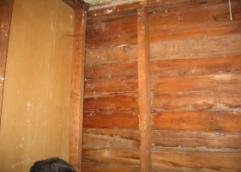 |
|
Digital image of exposed interior stud
|
|
| Use of the thermal imaging camera can in many cases locate these problems by showing subsurface defects. However, it takes not only the skill of a thermographer, but also an intense knowledge of the possible insect pests normally found in the local area as well as an understanding of the type of damage each different pest can cause. Only with that knowledge, can a proper inspection and image interpretation be accomplished. | 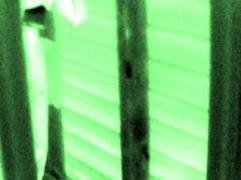 |
|
Colorized image of subsurface
defect in interior stud |
 |
 |
|
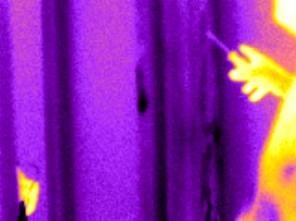
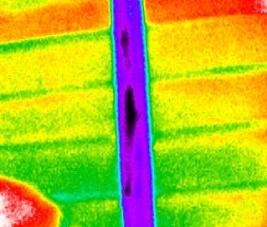
Subsurface defects shown in both images using active thermography – Orlando, FL. |
|
As an example, drywood termites habitually infest a piece of wood and create galleries within that wood structure. These galleries are simply tunnel-like voids that have been eaten out by the termites or other woodborers. The termites may remain hidden for years. Generally, they create a kick-hole that is used to expel their droppings (frass). If this frass is dropped behind or within a wall structure, it may not be seen. If however, a swarm takes place, and reproductive termites take to the air in search of finding a new nesting area, their presence may be noted and then the search for the termite gallery will begin.
A drywood infestation may be in any piece of wood; in a door jam, in an attic, or even in the wood stud within a wall structure. In order to locate them, the insect pest thermographer may need to resort to active thermography to determine their presence. Active thermography may consist of actively heating or even cooling structural areas while being viewed through the IR camera. Heating may be accomplished by using the thermal wave technique, which is an extension of basic heat conduction theory. The surface of the area is briefly and uniformly heated by a brief flash from a flash lamp
array. If the area has no gallery, the heat will diffuse fairly uniformly. Similarly, cooling agents may be utilized to accomplish similar results.
If, on the other hand, there are termite or other pest galleries present, the flow of heat into the structure will be obstructed and the rate of cooling at the surface immediately above the gallery would be retarded. Cooling agents can also be used. If the inspector is able to locate a kick hole, he then has the ability to inject a short blast of cooled compressed air, which when released into the hole, will invade the gallery and the cooling effect will become evident on the thermal imager. Active thermography is in some cases, the only way in which the insect pest infestation will be fully located. Above are several images showing the results of active thermography.
Additional Uses of the Thermal Imager in Pest Management
From time to time, during the process of performing a pest inspection, the pest thermographer will undoubtedly encounter many different situations that can be of benefit to his client. Rodent and other small animal nests within walls, crawl spaces or in attics are an additional problem. The thermal imager will be of great assistance in locating those warm blooded critters making nests in the attic, in the crawl spaces or even inside walls. Care needs to be taken when active nests are located. A startled rodent can cause serious problems for a thermographer who has a fear of rodents or who is suddenly surprised. Safety of balance, especially when in tight crawl spaces, in attics or on ladders is a must.
In addition, occasionally, there may be a strong odor coming from the inside of walls, attics or crawl spaces. Don’t be surprised to find dead animals with the uses of your thermal imager. Simply wear appropriate clothing and protective gear when removing the carcass.
| Since part of the pest detection inspection process also includes scanning such things as the electrical panels and plumbing areas, it will not be unusual to locate electrical problems like undersized wires, defective circuit breakers or loose connections or leaks not only from plumbing problems but from defects in the roofing or construction. | 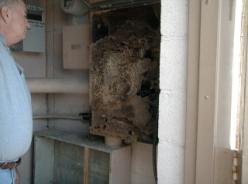 |
| Insect pests have been known to infiltrate electrical panels. The termite carton nests above can pose serious problems.
Jack Leonard – New Orleans. |
|
| Additionally, while performing the pest inspection, the thermographer will encounter the usual building envelope problems such as missing, poor or no insulation, outside air intrusion, duct leaks, heat and cold loss and the usual other thermal imaging discoveries that are ingredients in residential or commercial thermal inspections. These findings can be incorporated into a single inspection or can be separated into a subsequent inspection, thus providing the thermographer with a second earnings source from another inspection. | 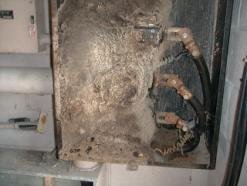 |
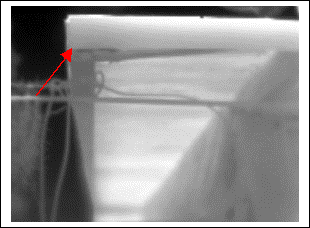
| In addition, since the use of thermal imaging will permit the ability to see inside wall structures, the use of the imager to locate appropriate locations for chemical treatments or for the remediation of a pest problem is an essential tool. As can be seen in the image at the right, assume that an infestation has been found in a cathedral ceiling, the usage of a thermal imager will permit the placing of the required treatment chemicals in the required locations. If a section is missed, it may provide harborage for the insect pest to survive. | 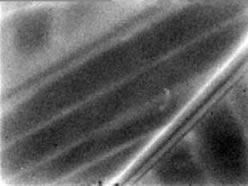 |
Additionally, as part of any pest treatment program, two factors for a successful treatment are necessary. One, if there was a contributing factor such as moisture providing conducive conditions, the contributing factor must be removed. Use of the thermal imager will confirm that the moisture issue has been resolved. Secondly, once
treatment has been effected, it is customary and of good practice to confirm the effectiveness of that treatment. The thermal imager can play a role in that confirmation process, but again, is but one of the tools to be utilized in the process.
Verification of Data or Findings
In the inspection process for insect pests, it is important to understand that the detection process also includes the verification of the data or the findings. Digital and IR images need to be captured and recorded. Use of additional equipment to verify the findings and to ascertain the presence or not of the suspected insect pest is an absolute must. The following is a brief list and description of some equipment that can be used to provide and verify data and results:
|
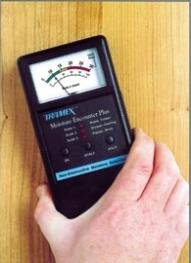
Moisture Meters:
Locating the presence of latent moisture is not enough. A pest thermographer must then confirm the presence and level of moisture. Usually, a moisture meter will be employed. Tramex Moisture Meter |
 |
|
Microwave Detection Equipment:
Termatrac® is a hand-held portable detection device using patented microwave technology. Termatrac® can detect insects and other pests in unseen areas such as wall voids, cracks, crevices, air pockets, construction flaws, beneath floors, and in ceilings, etc. Termatrac® will detect activity through a variety of materials such as brick, wood, stucco, concrete block, ceramic tile, marble, terracotta tile, mica, plastic veneers, vinyl and many other materials. Termatrac® is non-invasive and non-destructive, thereby avoiding damage to a client’s property. |
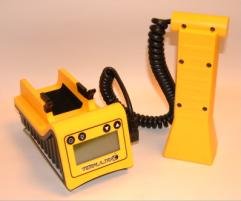 |
|
Acoustic Emissions Detection Equipment:
AED 2000L is a portable hand-held instrument that is the most advanced and sensitive acoustic detection system for locating termites and hidden insect pest infestations in wooden structures, trees, plants and soil. The AED, a product of several years collaboration with the USDA Agricultural Research Service literally permits the user to listen to the insect pests eating their way though wood or even in some cases walking. |
 |
|
Structural Test Equipment:
The Resistograph is an instrument that is utilized to measure the structural integrity of wood structures. Utilizing a very fine drill, the Resistograph, as the drill penetrates the wood structure at a predetermined rate and torque, measures the resistance and changes in torque to provide a printable data record of the probing actions. If there is an insect pest gallery present or if there is wood decay, the Resistograph will provide the data necessary to make a structural analysis of the situation. |
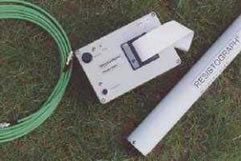 |
|
Boroscopes and Video Imaging Boroscopes:
Boroscopes, both manual and video imaging, can provide crucial confirmation of the presence of insect pest infestations. Inserted through a tiny hole, the boroscope probe can be manipulated to the suspected area of infestation where visual confirmation can be obtained. Either video or digital imaging cameras can be utilized to record the findings. |
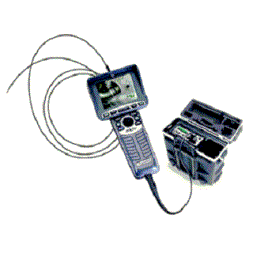 |
Special Challenges
For the Infrared Pest Thermographer there are special challenges that need to be met and unusual occurrences possible within any inspection and some of these items should be treated as specific subjects to be discussed at length at another time.
There are however, some special challenges that need to be mentioned and repeated from above:
-
Pest management thermography should really be classified as a specialty. It is easier to become a pest thermographer if you have a pest management background with pest management field experience. It is much more difficult to do it in reverse.
-
The liability factors can be quite severe and one must make sure that one is properly insured.
-
Historical sites pose additional issues. In many instances, the use of additional tools to validate findings may pose problems. Make sure that the inspection do’s and don’ts have been spelled out.
-
Structural problems may also be existent. In areas where termite activity may result in structural failures, the inspector needs to be aware for potential structural failures or issues.
-
In recent times, there have been some unique inspections utilizing thermal imaging. Subjects that have never been inspected using thermal imaging before require extreme caution due to possibly unexpected results. It’s one thing to do an inspection in a field that has been inspected before, it’s quite another to inspect a subject or item that has never been inspected before. The possible results are unknown and even if a thermographer feels he might have enough experience to handle the job, it may be safer, cheaper and much less of a liability to pass on the inspection or refer it to someone else who might be more capable of performing the job.
-
The pest management business is notoriously cheap. The pest management profession will do inspections for next to nothing to get the treatment job. As a professional thermographer, your equipment is very costly and your time is valuable. You are, after all, a professional and need to be properly compensated for your expertise. Converting the pest management profession to understand that is a challenge.
-
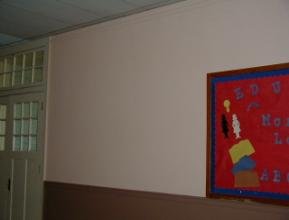
A final caution. It is additionally important to know your equipment and its capabilities. Sometimes one must realize that you may not have the right imager for the job. Also, you may have the right type of imager but perhaps the sensitivity of your imager itself makes it the wrong imager for the job. Additionally, it is the author’s opinion that color viewfinder images have a tendency to wash out the tonal contrasts needed to detect many of the anomalies associated with pest problems. Look at the following:
 |
 |
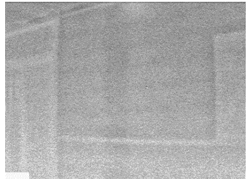
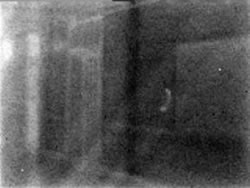
A field study was performed by Jack Leonard in New Orleans utilizing 2 comparable uncooled IR cameras – one being the Palm IR250 with various lenses and the other being the IR-100/ISI Insight. The results are shown here. The digital picture at top left shows the subject area. The image at the upper right was taken with the Palm IR250 with a 50mm lens. The image at the lower left was also taken with the Palm IR250 with a 25mm lens. The image at the lower right was taken with the Protec IR-100/ISI Insight with a 20mm lens. Though similar in nature, the image at the lower right revealed more detail and showed an anomaly more clearly than the other, more costly camera.
 |
 |